


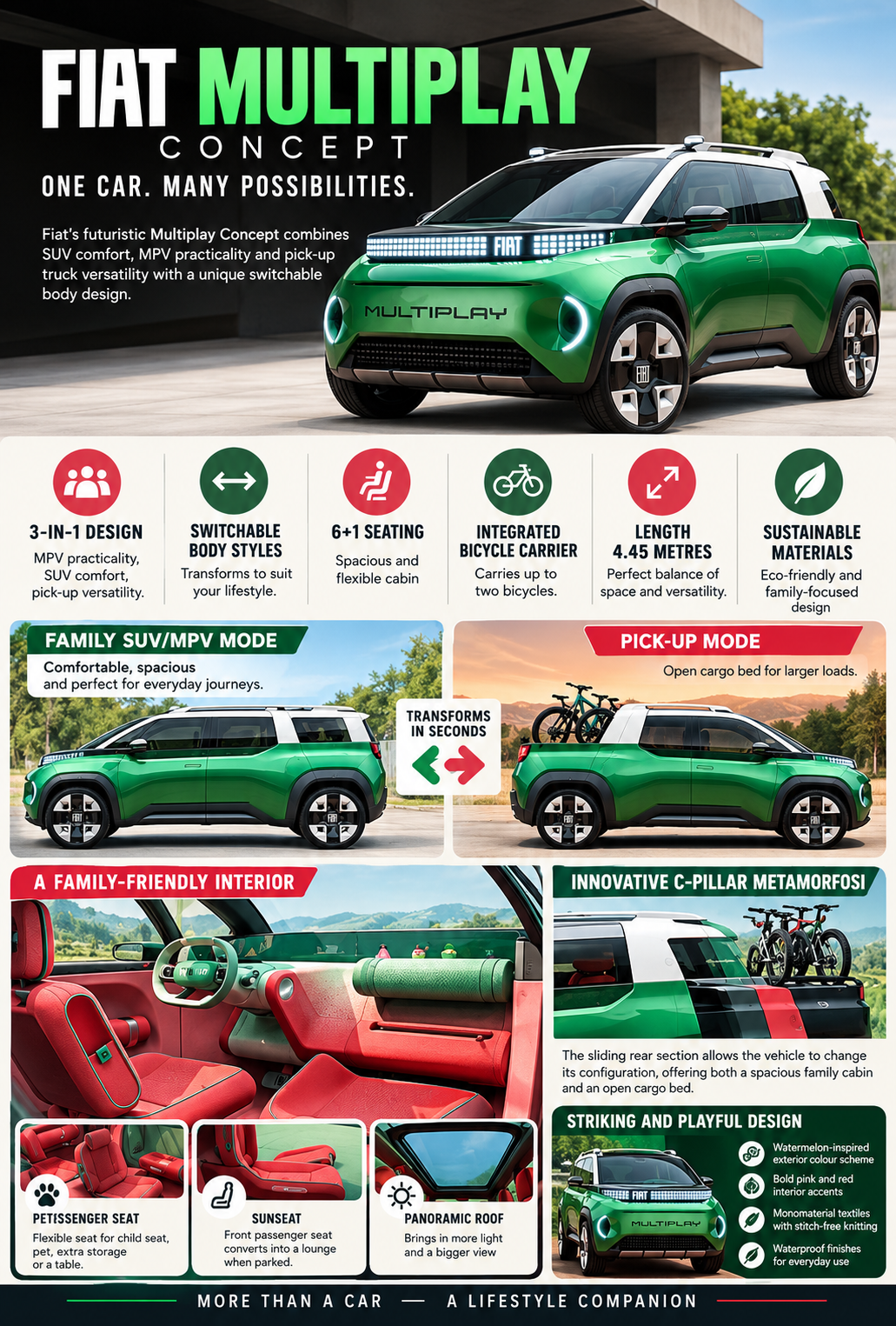
Fiat’s 4.45-metre Multiplay concept explores a new approach to vehicle versatility, combining the comfort of an SUV, the space of an MPV and the utility of a pick-up through a movable rear-body design.
Italian manufacturer Fiat has presented an unconventional vision for future family transportation with the Multiplay Concept. Designed to serve multiple purposes, the vehicle can switch between an enclosed passenger vehicle and a pick-up-style configuration with an open cargo area.
Presented at the 2026 Paris Motor Show, the concept challenges the traditional idea that buyers must choose between a spacious family car and a vehicle designed to transport bulky equipment. Its design brings together the passenger-focused layout of an MPV, the appeal of an SUV and the load-carrying capability of a pick-up.
At the centre of this concept is Fiat’s C-Pillar Metamorfosi system, a movable rear-body structure that changes the vehicle’s layout according to the requirements of its occupants.
While Fiat has yet to announce plans for a production model, the Multiplay offers a glimpse into how adaptable vehicle designs could better accommodate the changing needs of modern households.
Fiat Multiplay Concept: Major Features at a Glance
- Versatile body design: Combines the functions of an SUV, MPV and pick-up in a single vehicle.
- Overall length: 4.45 metres.
- Movable rear structure: A sliding body section enables the transition between passenger and cargo configurations.
- Passenger configuration: Six seats with an additional flexible seventh position.
- Cargo configuration: Four-seat layout with an exposed loading bed.
- Bicycle transportation: A rear spoiler that doubles as a carrier for two bicycles.
- Flexible cabin: Features a convertible front passenger seat, panoramic glass roof and provisions for travelling with pets.
- Market availability: Remains a concept study, with no production or launch timeline confirmed.
A Body That Changes to Suit Different Needs
Most passenger vehicles retain the same body layout regardless of whether they are carrying people, luggage or recreational equipment. Fiat takes a different approach with the Multiplay, exploring a structure that can physically adapt to these changing requirements.
The manufacturer’s C-Pillar Metamorfosi architecture uses a sliding rear module to modify the space available for passengers and cargo. In its passenger-oriented layout, the vehicle provides an enclosed cabin suited to everyday family journeys. When greater load-carrying flexibility is required, the rear section can be repositioned to expose a dedicated cargo area.
This transformation changes both the vehicle’s interior arrangement and its intended use. The family configuration accommodates more occupants, while the pick-up layout prioritises space for larger objects that may not fit comfortably inside a conventional SUV or MPV.
Potential uses include transporting bicycles, camping accessories, outdoor recreation equipment and other bulky belongings.
Fiat has also incorporated a multifunctional rear spoiler into the design. Rather than serving solely as an exterior styling element, it can be repurposed as a bicycle carrier with room for two cycles.
The concept therefore focuses on making one vehicle useful across different situations instead of requiring owners to compromise on passenger space or purchase a separate utility vehicle.
Comparing the Two Multiplay Configurations
The Multiplay retains its 4.45-metre exterior length in both layouts, while the rear-body mechanism changes how the available space is used.
| Feature | Family configuration | Pick-up configuration |
|---|---|---|
| Seating arrangement | Six seats plus a flexible additional position | Four seats |
| Rear section | Enclosed passenger compartment | Open cargo bed |
| Main purpose | Everyday family travel | Transporting bulky items |
| Typical use cases | Children, pets and luggage | Bicycles, sports equipment and outdoor gear |
| Overall length | 4.45 metres | 4.45 metres |
The additional position in the family layout is intended to provide flexibility for family-related needs. It should not automatically be interpreted as a conventional seat offering standard seven-adult accommodation.
A Cabin Tailored to Families, Children and Pets
Beyond its adjustable exterior structure, Fiat has explored ways to make the Multiplay’s interior more adaptable to everyday family life.
One of the concept’s distinctive features is the Petsenger seat, a multifunctional cabin element designed to accommodate different requirements. Depending on its configuration, it can support a child-seat arrangement, provide a designated space for a pet, serve as a small table or offer additional storage capacity.
This approach reflects the different demands placed on family vehicles today. A single journey may involve transporting children, travelling with pets or carrying equipment for recreational activities, making flexible interior arrangements particularly useful.
Rather than dedicating every interior component to one fixed purpose, Fiat has explored how cabin elements can serve multiple functions.
Sunseat: A Front Passenger Seat That Becomes a Lounge
The front passenger seat introduces another example of the Multiplay’s adaptable design. Called the Sunseat, it can be converted into a lounge-style arrangement when the vehicle is stationary.
The feature is intended to create a comfortable place to relax beneath the panoramic glass roof, turning the cabin into a more leisure-oriented space when the car is parked.
The interior also features generous glazing, large windows and a minimalist dashboard layout. Together, these elements are intended to make the cabin feel bright and open.
Another unusual detail is the dashboard display, which is designed to retract from view when the vehicle is switched off. This contributes to the concept’s clean, uncluttered interior aesthetic.
Colourful Styling and a Focus on Material Efficiency
Fiat has given the Multiplay a distinctive visual identity through a watermelon-inspired colour palette. The exterior combines bright green tones, while the cabin features contrasting pink and red accents.
Material selection is another part of the concept’s design approach. The interior incorporates monomaterial textiles created using a stitch-free 3D knitting technique, with the stated aim of reducing material waste during production.
Practicality has also influenced the choice of finishes. Waterproof surfaces in areas intended for children and pets are designed to make the cabin more suitable for everyday use.
These details complement the vehicle’s broader objective: combining an expressive design with features intended to support the varied routines of modern families.
Carrying Forward Fiat’s History of Unconventional Family Cars
The Multiplay draws on a tradition of experimental packaging that has featured in Fiat’s history for decades.
Introduced in 1956, the original Fiat 600 Multipla demonstrated how a compact vehicle could accommodate six occupants despite its relatively small footprint. Its distinctive layout challenged conventional ideas about how interior space should be arranged.
The 1998 Fiat Multipla continued this unconventional approach with its three-plus-three seating configuration, featuring three seats in each of the two rows.
The new Multiplay takes this philosophy in a different direction. Instead of focusing primarily on fitting more occupants into a compact vehicle, it explores how the vehicle’s body itself can be reconfigured for different tasks.
This marks a shift from simply improving the use of interior space to changing the relationship between passenger accommodation and cargo capacity.
Fiat Multiplay Concept: What Is Known About Its Powertrain?
Fiat has not released detailed mechanical specifications for the Multiplay Concept. Information regarding its engine or motor, battery capacity, driving range, power output and performance remains unconfirmed.
It is therefore too early to determine whether a potential production vehicle using this design approach would feature a fully electric powertrain, a hybrid system or a conventional internal-combustion engine.
Other important engineering details have also not been disclosed. These include the technical operation of the sliding rear-body assembly, the mechanism’s long-term durability, cargo payload limits, safety certification and the feasibility of manufacturing the design at scale.
For now, the Multiplay is best understood as an exploration of vehicle packaging and multifunctional design rather than a production-ready model with established technical specifications.
Does the Fiat Multiplay Have Potential in India?
Fiat has not announced an Indian launch for the Multiplay Concept, nor has it confirmed that a production vehicle based on this design will be developed.
Nevertheless, the concept presents an interesting proposition for a market where buyers often prioritise family comfort, passenger space and everyday practicality.
A vehicle that can function as a family car during the week and accommodate larger equipment for weekend trips could appeal to customers who enjoy outdoor activities or prefer to own one versatile vehicle rather than separate passenger and utility vehicles.
However, the concept would face several practical hurdles before such a product could become commercially viable in India.
The sliding body mechanism would need to meet requirements for structural strength, reliability and occupant protection. Fiat would also have to consider manufacturing costs, vehicle homologation and the impact of the additional mechanical complexity on the final selling price.
Another important consideration is the vehicle’s size. At 4.45 metres long, the Multiplay exceeds the four-metre length threshold associated with India’s tax-favoured sub-four-metre passenger-car category. Any future Indian-market application would therefore need to be positioned with the relevant taxation, pricing and competitive landscape in mind.
Whether the concept could translate into a practical offering for Indian buyers will depend on how these challenges are addressed.
Conclusion
The Fiat Multiplay Concept presents an alternative way of thinking about family mobility. By combining an enclosed passenger cabin with a transformable rear section, it explores the possibility of bringing SUV comfort, MPV practicality and pick-up functionality together in one vehicle.
Its flexible seating arrangements, multifunctional interior components, bicycle-carrying solution and lounge-style passenger seat demonstrate how a vehicle could adapt to different activities throughout the day.
However, the concept remains an exploratory design, and Fiat has yet to confirm production plans, technical specifications or market availability.
For now, the Multiplay stands out as an example of how future vehicle design could focus not only on the space a car offers, but also on how effectively that space can change to meet its owner’s needs.


