


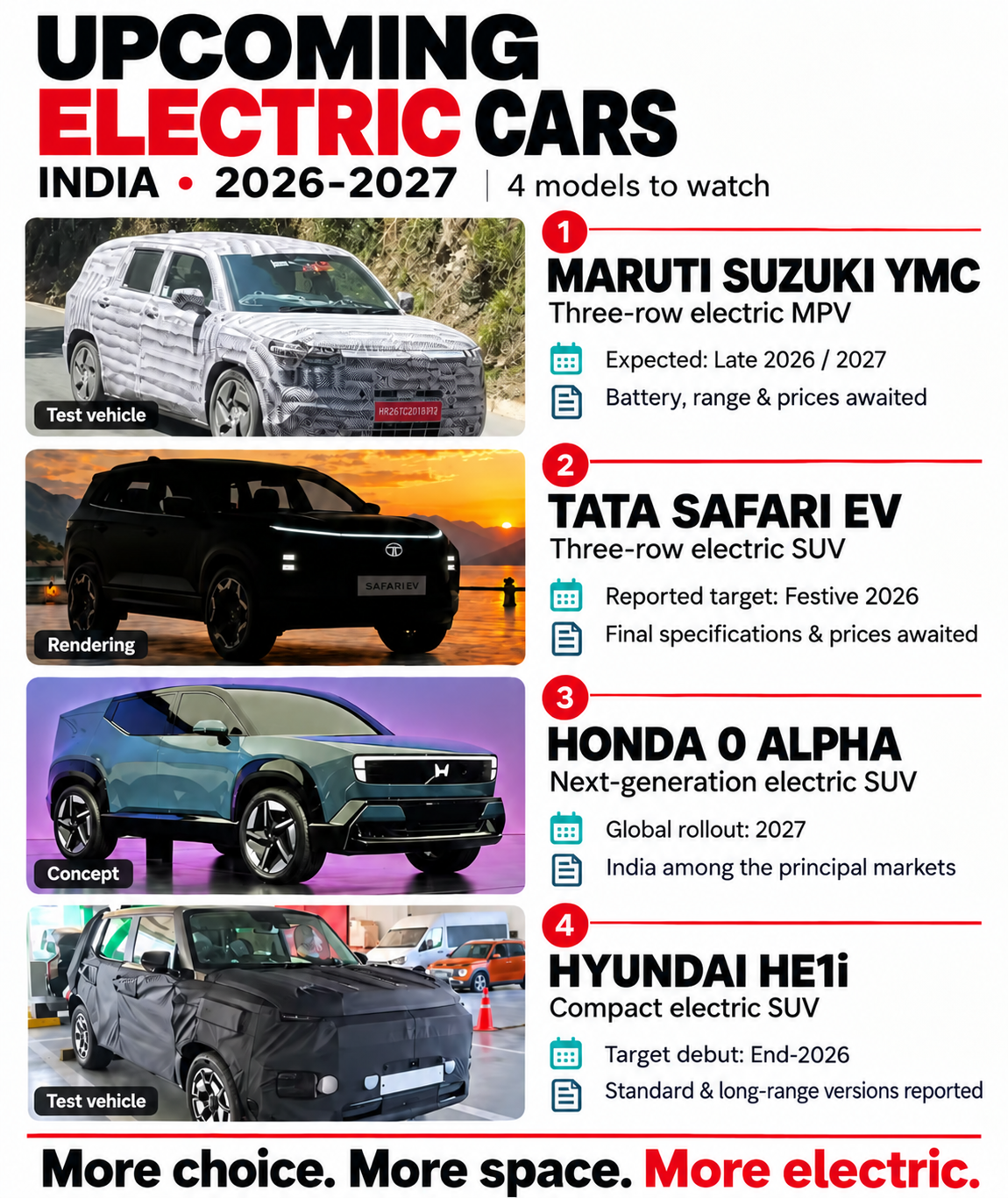
India’s electric passenger vehicle market could soon see new entrants designed for a broader range of customers. Maruti Suzuki is reportedly developing an electric MPV for larger families, while Tata Motors is expected to expand its electric SUV lineup with the Safari EV. Honda has announced plans to begin the global rollout of its 0 Alpha electric SUV in 2027, with India identified as a key market. Meanwhile, Hyundai is working on a locally developed electric SUV aimed at Indian buyers.
Each model could serve a different purpose, whether it is accommodating more passengers, providing additional cabin space or offering an electric vehicle suited to daily urban commutes. However, buyers will need to wait for official announcements regarding pricing, specifications and final launch schedules.
Four Upcoming Electric Cars to Keep an Eye On
| Upcoming EV | Expected Body Style | Anticipated Launch | Current Status |
|---|---|---|---|
| Maruti Suzuki YMC | Three-row electric MPV | Late 2026 or 2027, as reported | Production name, technical details and launch date are yet to be confirmed |
| Tata Safari EV | Three-row electric SUV | Expected during the 2026 festive period, according to reports | Pricing and final specifications are awaited |
| Honda 0 Alpha | Electric SUV | Global rollout scheduled to begin in 2027 | Development programme announced by Honda |
| Hyundai HE1i | Compact electric SUV | End of 2026 is the reported target | India-specific model confirmed, with detailed specifications pending |
The launch periods listed above are based on available company announcements and media reports. They should not be treated as confirmed showroom arrival or delivery dates.
1. Maruti Suzuki YMC: An Electric MPV Built Around Family Needs
Maruti Suzuki could expand its electric vehicle portfolio with a new MPV currently referred to by its reported internal codename, YMC. Unlike the e Vitara, which belongs to the SUV segment, the upcoming model is expected to focus on passenger accommodation and family-oriented practicality.
Reports suggest that the YMC could use the same underlying platform as the e Vitara and feature three rows of seats. The vehicle could arrive in late 2026 or during 2027, although Maruti Suzuki has yet to confirm its final name, battery options, driving range or pricing.
An electric MPV could appeal to customers who need a vehicle for regular family travel. While battery capacity and driving range are important considerations, buyers in this segment are also likely to prioritise comfortable seating, convenient entry and exit, flexible cabin arrangements and sufficient luggage space.
Using an existing EV architecture could also help the manufacturer share development costs across models. However, the final battery configuration, efficiency and price will depend on the specifications chosen for the production vehicle.
Auto Punditz perspective: The YMC could become a relevant option for families looking to move to electric mobility without sacrificing passenger capacity. Its practicality will ultimately depend on the space available when all three rows are occupied, along with its real-world highway range and overall ownership cost.
2. Tata Safari EV: Bringing Three-Row Seating to Tata’s Electric SUV Range
Tata Motors is expected to introduce the Safari EV as a larger electric SUV positioned towards the upper end of its EV portfolio. The model is anticipated to become the brand’s first three-row electric offering, extending its electric lineup beyond smaller SUVs.
The upcoming vehicle is expected to share elements of its technical foundation with the Harrier EV. Reports have also pointed towards potential 65kWh and 75kWh battery options, alongside rear-wheel-drive and all-wheel-drive configurations. These details, however, remain subject to official confirmation.
The Safari EV could appeal to households that require additional seating and prefer the elevated driving position and substantial proportions of an SUV. It may also provide an alternative for buyers who want an electric vehicle suitable for both everyday travel and longer family journeys.
Its overall usability will depend on more than battery size. Charging speed, energy consumption under load, third-row comfort, ride quality and luggage capacity will all play a role in determining whether the electric Safari meets the expectations associated with a large family SUV.
Auto Punditz perspective: The Safari EV has the potential to strengthen Tata’s position in the family EV segment. To make a convincing case, it will need to combine a genuinely usable third row with reliable long-distance performance and pricing that remains competitive against other premium electric SUVs.
3. Honda 0 Alpha: Honda’s Next Step Towards Electric Mobility in India
Honda’s upcoming 0 Alpha, officially designated the Honda 0 α, represents part of the Japanese automaker’s next-generation 0 Series electric vehicle programme. The company presented the prototype at the Japan Mobility Show in October 2025 and announced that the production model’s global rollout would commence in 2027, with Japan and India among its primary markets.
Positioned as the entry-level model in the 0 Series family, the 0 Alpha is intended to introduce Honda’s new electric vehicle design direction to a wider audience.
The concept focuses on efficient use of space, with Honda highlighting a relatively low body profile while maintaining ground clearance and a spacious interior. Its styling features distinctive lighting elements at the front and a U-shaped rear lighting signature, giving the vehicle a recognisable appearance.
Honda has not yet established the India-specific battery capacity, official driving range or pricing in the announcements reviewed. These details will be important in understanding where the production model fits within India’s competitive electric SUV market.
Beyond its design, the vehicle’s success will depend on how effectively Honda adapts the product to local requirements. Pricing, charging compatibility, after-sales support and the availability of EV-trained service facilities could all influence its appeal.
Auto Punditz perspective: The 0 Alpha gives Honda an opportunity to establish a stronger presence in India’s electric passenger vehicle segment. Its design and packaging could attract attention, but competitive pricing and a dependable ownership experience will be essential to convert that interest into demand.
4. Hyundai HE1i: A Locally Developed Electric SUV for Everyday Use
Hyundai is preparing a new electric SUV specifically aimed at the Indian market. Commonly referred to by its reported internal codename, HE1i, the vehicle is expected to target buyers looking for a compact, practical and technology-focused electric vehicle.
Its launch timeline has seen different indications. An earlier report pointed to a debut by March 2027, while subsequent comments from Hyundai Motor India’s managing director and CEO, Tarun Garg, indicated a possible introduction towards the end of 2026. Hyundai’s 2026 Investor Day announcement also identifies the fourth quarter as the intended introduction period for its new India-focused electric SUV.
The company has confirmed that the vehicle will be localised and developed with Indian customers in mind. Announced features include a next-generation infotainment system and Level 2 advanced driver-assistance technology.
Media reports have suggested that the SUV could be offered in standard-range and long-range configurations. However, Hyundai has not yet confirmed the detailed specifications, battery sizes, pricing or final driving range for the Indian version.
If multiple range options are offered, customers could have greater flexibility when choosing between affordability and the ability to undertake longer journeys. Local development could also help Hyundai tailor the vehicle’s equipment and packaging to the requirements of the domestic market.
Auto Punditz perspective: Hyundai’s upcoming electric SUV could appeal to a broad group of urban and family buyers if it delivers the right balance of price, usable range and interior space. Technology features may help it stand out, but everyday efficiency, convenient charging and long-term ownership costs will be equally important.
What Buyers Should Evaluate Before Choosing an Upcoming EV
With several new electric vehicles expected to enter the market, buyers should look beyond launch announcements and headline specifications. The following factors can make a meaningful difference to everyday usability.
1. Total cost of ownership
Compare the vehicle’s purchase price with the cost of installing a home charger, charging expenses and other recurring ownership costs. The lowest upfront price does not necessarily translate into the lowest overall expense.
2. Driving range in everyday conditions
Manufacturer-claimed range figures should be assessed alongside expected real-world usage. Highway speeds, air-conditioning, passenger occupancy and luggage can influence the distance an EV covers on a full charge.
3. Charging time and compatibility
Peak charging power is only one part of the equation. Buyers should consider the time required to reach a useful charge level, compatibility with available charging infrastructure and access to convenient charging points along regular routes.
4. Space and seating flexibility
For family-oriented vehicles, cabin dimensions and seating arrangements deserve close attention. Buyers considering a three-row MPV or SUV should check third-row access, adult passenger comfort and the amount of luggage space remaining with every seat in use.
5. Battery warranty and service network
Warranty coverage, battery-related terms and access to trained technicians can influence the long-term ownership experience. Buyers should also assess the availability of service centres and charging support in the areas where they regularly travel.
Conclusion
The upcoming electric vehicles from Maruti Suzuki, Tata Motors, Honda and Hyundai could expand the choices available to Indian customers across multiple segments. The Maruti Suzuki YMC is expected to focus on family-friendly MPV practicality, the Tata Safari EV could bring three-row seating to the brand’s electric SUV range, Honda’s 0 Alpha is part of its next-generation EV strategy, and Hyundai’s HE1i is being developed with the Indian market in mind.
Although these models address different customer needs, their eventual competitiveness will depend on the same fundamentals: realistic driving range, convenient charging, useful cabin space, reliable after-sales support and pricing that reflects their intended positioning.
For prospective buyers, the sensible approach is to monitor official announcements and wait for confirmed specifications before making a purchase decision. Once prices, battery configurations and delivery timelines become available, these four EVs can be compared more meaningfully against existing alternatives in the Indian market.


