


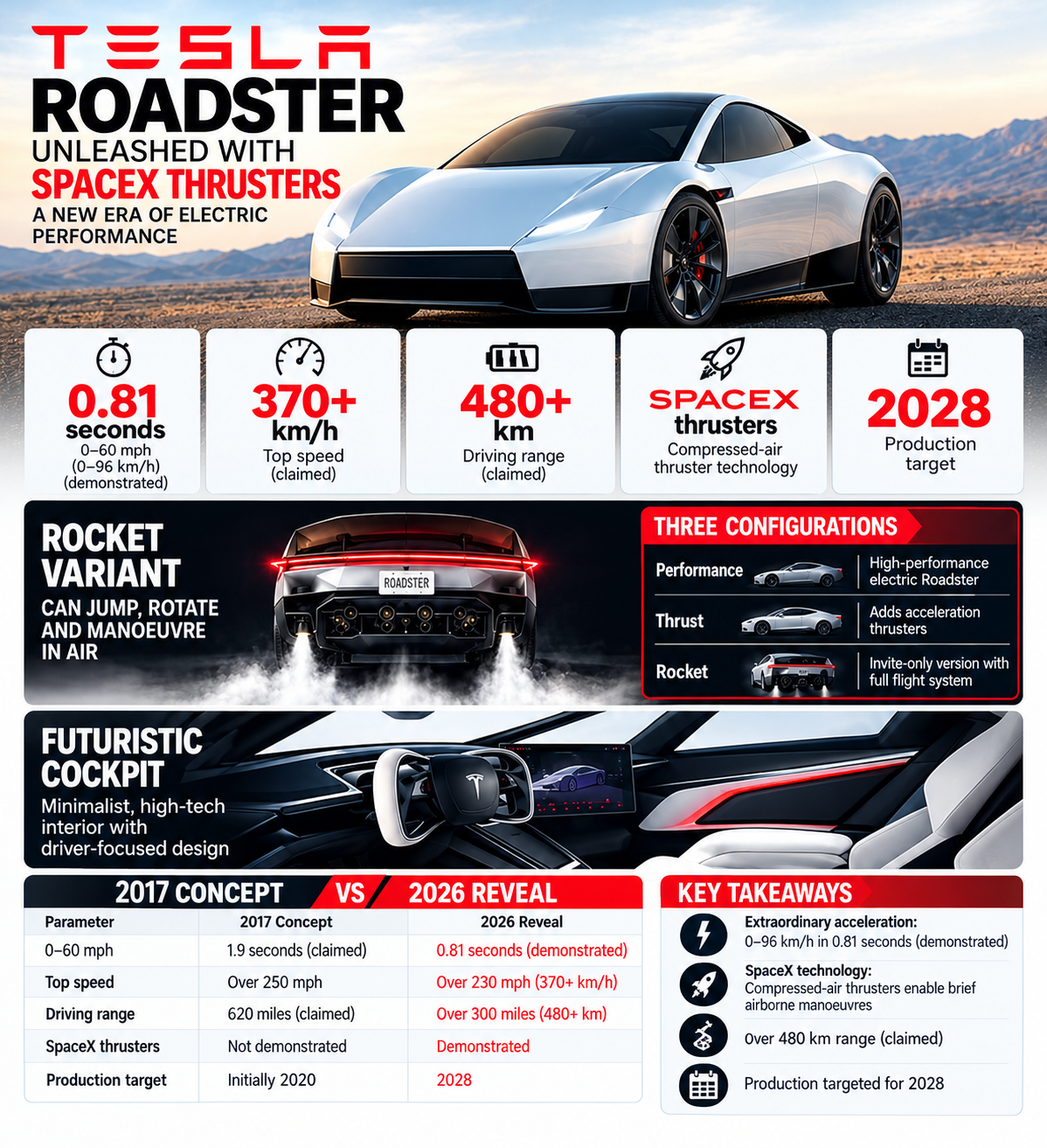
Tesla has revealed its redesigned second-generation Roadster at SpaceX’s test facility in McGregor, Texas, on October 15, 2026. The unveiling comes almost nine years after the electric sports car’s original concept was presented in 2017.
The latest iteration pushes beyond conventional electric sports-car engineering, combining high-performance electric propulsion with aerospace-inspired technology. One of the event’s biggest highlights was a demonstration in which the vehicle lifted off the ground, performed a mid-air rotation and returned to the ground using compressed-air thrusters.
Tesla also showcased an acceleration run from 0 to 60 mph (approximately 96.6 km/h) in just 0.81 seconds. However, this extraordinary figure has not been independently verified.
The company is targeting 2028 for production. It has yet to announce final vehicle prices, a confirmed production specification sheet or plans for an Indian launch.
Tesla Roadster: Key Highlights
- Redesigned second-generation all-electric sports car.
- SpaceX-inspired compressed-air thruster technology.
- Demonstrated 0–60 mph acceleration in 0.81 seconds.
- Claimed maximum speed exceeding 370 km/h.
- Three configurations: Performance, Thrust and Rocket.
- Rocket version designed for experimental airborne manoeuvres.
- Active aerodynamic components and an underbody suction system.
- Production target set for 2028.
- Final pricing and Indian availability remain unconfirmed.
SpaceX Technology Enables Experimental Flight Manoeuvres
The most unusual aspect of the new Roadster is its demonstrated ability to perform manoeuvres beyond the capabilities of conventional road-going sports cars.
During the presentation, Tesla showcased an underbody fan-based suction system that enabled the vehicle to travel along an inverted ramp. The demonstration also included a mid-air rotation followed by a controlled landing, assisted by compressed-air thrusters.
In another sequence, the Roadster lifted itself over a row of stationary Tesla vehicles. Unlike conventional combustion-based rocket propulsion, the demonstrated thruster system relies on compressed air.
These technologies are intended to deliver exceptional acceleration and manoeuvrability. Nevertheless, their practical application remains uncertain, particularly for public-road use. Tesla has not established that the more extreme airborne functions can legally be used on ordinary roads.
The demonstrations therefore represent an experimental extension of electric-vehicle performance rather than a conventional feature set for everyday driving.
Three Versions of the New Tesla Roadster
Tesla has outlined three configurations for the upcoming electric sports car, with each offering a different level of performance and technology.
| Configuration | Main distinction |
|---|---|
| Performance | Standard high-performance electric sports car |
| Thrust | Adds acceleration-enhancing thruster technology |
| Rocket | Invite-only version featuring a more comprehensive flight system |
The Performance variant is aimed at buyers seeking a high-performance electric sports car, while the Thrust version adds specialised propulsion assistance. The Rocket configuration sits at the extreme end of the range, incorporating the experimental flight capabilities demonstrated at the unveiling.
Tesla has indicated reservation deposits of $50,000 for the Performance version and $250,000 for the Thrust version. These amounts represent reservation deposits, not the final purchase prices of the vehicles.
Pricing for the complete lineup, including the Rocket configuration, has not been fully confirmed.
Acceleration, Top Speed and Driving Range
The new Roadster’s performance claims are among its most attention-grabbing attributes. Tesla demonstrated a 0–60 mph run in 0.81 seconds, a figure that would place the vehicle in an extraordinary performance category if independently reproduced under clearly defined testing conditions.
The company has also indicated a top speed exceeding 230 mph, equivalent to approximately 370 km/h. Reports surrounding the unveiling suggest a potential driving range of more than 300 miles, or around 480 km.
However, Tesla has not yet released a complete final specification sheet for the production model. The figures should therefore be treated as preliminary rather than independently established production-car performance.
| Parameter | Announced or reported figure |
|---|---|
| Acceleration, 0–60 mph | 0.81 seconds demonstrated |
| Maximum speed | Over 370 km/h claimed |
| Driving range | Over 480 km reported |
| Powertrain | Fully electric |
| Thruster system | Compressed air |
| Expected production | 2028 |
| Final vehicle price | Not announced |
Actual performance, range and equipment could differ in the production version. Independent testing will be important in establishing how closely the final car matches the figures presented during the reveal.
Futuristic Styling Meets Active Aerodynamics
The redesigned Roadster retains the low-profile proportions expected of an electric supercar while adopting a more futuristic appearance than the original concept shown in 2017.
Its exterior incorporates distinctive lighting elements, sculpted bodywork and an aerodynamic silhouette. Tesla has also highlighted an active rear wing and a fan-based underbody system designed to generate substantial downforce.
These aerodynamic technologies are intended to support high-speed stability and vehicle control. The fan-based suction system also forms part of the car’s more experimental capabilities, extending its engineering beyond conventional aerodynamic solutions.
Together, the revised design and aerospace-inspired systems illustrate Tesla’s attempt to combine electric-supercar performance with technology developed around unusual movement and vehicle control.
Tesla Roadster 2017 vs 2026: Major Differences
The latest reveal builds on the ambitious promises made when Tesla first introduced the second-generation Roadster concept in 2017.
| Parameter | 2017 concept | 2026 reveal |
|---|---|---|
| 0–60 mph | 1.9 seconds claimed | 0.81 seconds demonstrated |
| Top speed | Over 250 mph claimed | Over 230 mph claimed |
| Driving range | 620 miles claimed | Over 300 miles reported |
| SpaceX thrusters | Not demonstrated | Demonstrated |
| Original production target | 2020 | 2028 |
The most significant change is the acceleration figure, with the latest demonstration presenting a substantially quicker result than the original concept’s claim.
At the same time, the newly reported range and top-speed figures are lower than the ambitious targets announced in 2017. The two sets of numbers should be interpreted carefully because the latest vehicle’s final production specifications have not been established.
Neither generation’s headline performance figures should be considered independently verified production-car results without appropriate testing.
The production timeline has also shifted considerably. The original target was 2020, while Tesla is now aiming for 2028.
Tesla Roadster India Launch: Current Status
Tesla has not announced an India launch for the new Roadster. There is currently no confirmed Indian price, launch date, booking schedule or customer delivery timeline.
Its specialised propulsion technology, experimental capabilities and expected premium positioning distinguish it from electric vehicles intended for broader consumer markets.
If the Roadster eventually reaches India, its pricing and availability will depend on Tesla’s market plans and the final production specification. Until an official announcement is made, any projected Indian launch date or price would remain speculative.
A New Direction for Electric Sports Cars
The next-generation Tesla Roadster represents an ambitious attempt to push electric sports-car performance beyond acceleration and top speed. Its compressed-air thrusters, experimental flight demonstrations and active aerodynamic systems introduce technologies rarely associated with conventional road vehicles.
The Performance, Thrust and Rocket configurations are intended to serve different levels of performance ambition, while the 2028 production target gives Tesla additional time to develop the vehicle.
For now, the most important questions concern whether the demonstrated capabilities can be translated into a production-ready car, how the final specifications will compare with the announced figures, and what the completed vehicle will cost.
With production still planned for 2028, the new Roadster remains a highly ambitious electric sports-car project whose real-world capabilities will need to be assessed once a final production model becomes available.


