


Available in a six-seat configuration, the Volvo EX90 features a 106 kWh battery, dual electric motors and an all-wheel-drive system. It delivers a claimed WLTP range of 625 km and supports DC fast charging at up to 350 kW. The SUV also uses an 800V electrical architecture, enabling a claimed 10–80% battery recharge in approximately 22 minutes under suitable charging conditions.
The EX90 enters a growing luxury electric SUV segment, where it competes with the Kia EV9 and Mercedes-Benz EQS SUV. Its pricing, spacious cabin and technology-focused equipment package position it as a new flagship offering for buyers seeking an all-electric luxury family vehicle.
Volvo EX90: Key Specifications and Highlights
- India price: ₹1.26 crore, ex-showroom
- Battery capacity: 106 kWh
- Power output: 456 hp
- Maximum torque: 670 Nm
- Motor setup: Dual-motor all-wheel drive
- Claimed driving range: 625 km (WLTP)
- Acceleration, 0–100 km/h: 5.5 seconds
- Top speed: 180 km/h
- Electrical architecture: 800V SPA2
- Maximum DC charging capacity: 350 kW
- 10–80% DC charging time: Approximately 22 minutes
- AC charging capacity: 11 kW
- Seating configuration: Six passengers
Pricing and Market Position of the Volvo EX90
Volvo has priced the EX90 at ₹1.26 crore, placing it in the upper end of India’s luxury electric SUV market. According to the provided pricing figures, it costs approximately ₹27.2 lakh more than the petrol-powered XC90 while remaining competitively positioned against other premium electric SUVs with three-row seating.
Rather than serving merely as an electric substitute for an existing petrol model, the EX90 represents Volvo’s technology-led approach to flagship mobility. Its electric powertrain, advanced electronic systems and premium cabin are central to its positioning.
The combination of a long claimed range, rapid charging capability and a six-seat interior could appeal to families looking for an electric SUV that can accommodate both everyday journeys and longer trips.
Battery, Powertrain and Driving Performance
The India-spec EX90 uses a 106 kWh battery pack to power two electric motors. The resulting 456 hp output and 670 Nm of torque are delivered through an all-wheel-drive system.
| Specification | Volvo EX90 |
|---|---|
| Battery pack | 106 kWh |
| Maximum power | 456 hp |
| Peak torque | 670 Nm |
| Drive configuration | Dual-motor AWD |
| 0–100 km/h acceleration | 5.5 seconds |
| Maximum speed | 180 km/h |
| Claimed range | 625 km (WLTP) |
| Electrical platform | 800V SPA2 |
| Peak DC charging power | 350 kW |
| DC charging time, 10–80% | Approximately 22 minutes |
| AC charging | 11 kW |
Despite its substantial size and family-oriented design, the EX90 can accelerate from a standstill to 100 km/h in 5.5 seconds. Instant electric torque supports brisk acceleration, while the all-wheel-drive arrangement is designed to provide traction across different driving conditions.
The 180 km/h top speed is electronically limited, in keeping with Volvo’s approach to vehicle safety.
Real-World Range: Can the EX90 Cover More Than 580 km?
Volvo quotes a WLTP-certified driving range of 625 km for the EX90. However, the distance covered on a single charge will vary according to driving style, road conditions, outside temperatures, air-conditioning use and average speeds.
A test published by Autocar India reportedly recorded energy efficiency of around 5.5 km/kWh, translating into an estimated driving range of approximately 580 km under the conditions of that test.
This result suggests that the EX90 could be suitable for longer journeys, although the actual range achieved by individual owners may differ. Highway speeds, heavy traffic and weather conditions can all influence energy consumption.
For prospective buyers, the combination of a large battery and a claimed range above 600 km should reduce the need for frequent charging on suitable routes. Nevertheless, planning journeys around available charging stations will remain important, particularly when travelling between cities.
Fast Charging and Home Charging Capabilities
The EX90’s 800V electrical system is one of its major technological features. With compatible DC charging equipment, the SUV can accept charging power of up to 350 kW.
Volvo claims that charging the battery from 10% to 80% takes approximately 22 minutes under suitable conditions. Actual charging times will depend on charger output, battery temperature, battery state of charge and other operating conditions.
For regular overnight charging, the SUV supports 11 kW AC charging. A complete recharge using a compatible setup is estimated to take approximately 11 hours.
The high peak DC charging capability could make the EX90 more convenient for long-distance driving. However, Indian owners will need access to compatible high-power charging stations to benefit from the vehicle’s maximum charging potential.
For buyers primarily charging at home, installation arrangements, available electrical capacity and typical daily driving distances will be important considerations.
Exterior Styling: Volvo’s Distinctive Scandinavian Design
The Volvo EX90 follows the brand’s understated design philosophy, using clean body surfaces, restrained detailing and a modern electric-SUV silhouette.
At the front, the vehicle features Volvo’s signature Thor’s Hammer LED lighting design alongside a minimalist fascia and a largely closed-off grille area. The side profile is defined by its long wheelbase, expansive glass area and 21-inch alloy wheels.
At the rear, vertically oriented LED lighting maintains the familiar Volvo design identity while giving the SUV a distinctive appearance after dark.
Volvo EX90 Dimensions
| Dimension | Measurement |
|---|---|
| Length | 5,037 mm |
| Width | 1,964 mm |
| Height | 1,744 mm |
| Wheelbase | 2,985 mm |
| Standard ground clearance | 210 mm |
| Maximum raised ground clearance | Up to 250 mm |
The SUV also gets air suspension, which allows the ride height to be adjusted according to driving requirements.
Volvo offers the EX90 in six exterior colours: Crystal White, Denim Blue, Mulberry Red, Onyx Black, Sand Dune and Vapour Grey.
Interior Features and Six-Seat Comfort
The EX90’s cabin uses a 2+2+2 seating layout, with individual captain’s chairs in the second row. This arrangement prioritises personal space and creates a more premium environment for passengers travelling in the rear.
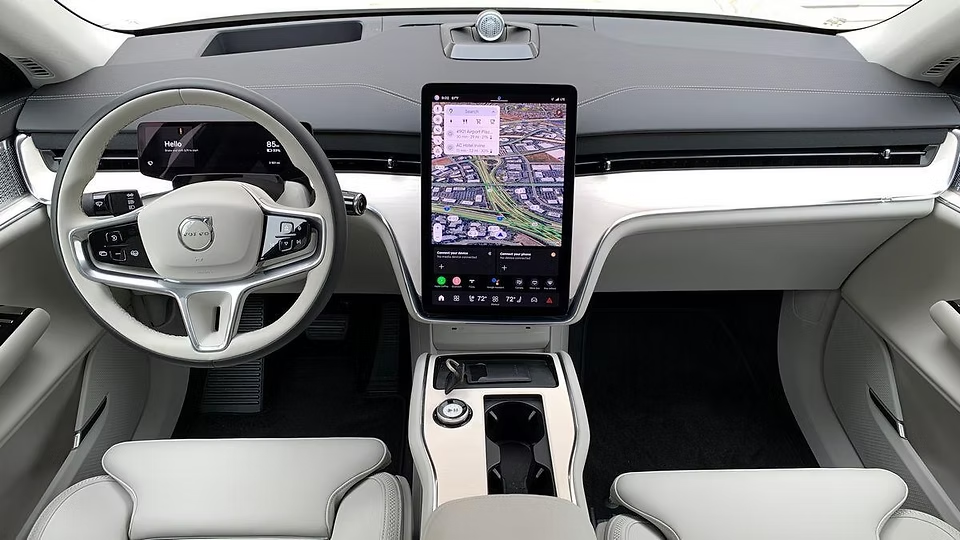
The interior combines Nappa leather upholstery and brushed aluminium accents with Volvo’s minimalist dashboard design. A vertically oriented 14.5-inch touchscreen serves as the main infotainment interface, while a separate 9-inch digital instrument display provides driving information.
A 25-speaker Bowers & Wilkins sound system is another key feature, adding a premium audio experience to the cabin.
Major Cabin and Convenience Features
- 14.5-inch touchscreen infotainment system
- 9-inch digital instrument cluster
- Nappa leather upholstery
- 25-speaker Bowers & Wilkins audio system
- Four-zone automatic climate control
- Panoramic glass roof with switchable transparency
- Wireless smartphone charging
- Digital key functionality
- 360-degree camera system
- Automatic parking assistance
- Cabin air purification system
The second-row captain’s chairs are designed to improve passenger comfort and provide a more individual seating experience. Their configuration also facilitates access to the third row.
However, the second-row seats do not offer powered adjustment, ventilation, heating or massage functions, unlike the front seats. This could be a drawback for buyers who expect extensive rear-seat amenities in a luxury SUV at this price.
The omission may be especially noticeable for chauffeur-driven customers, for whom second-row comfort is often a significant purchasing consideration.
Luggage Capacity and Everyday Usability
The Volvo EX90 offers 324 litres of luggage space when all three seating rows are occupied. Folding the third row increases the available boot capacity to 690 litres.
An additional 46-litre front storage compartment, or frunk, provides space for smaller items and charging accessories.
The six-seat layout gives the EX90 a practical family-oriented configuration, balancing passenger accommodation with premium comfort. However, the usefulness of the third row will depend on passenger height and journey duration, with children and occasional adult passengers likely to find it more suitable.
For families who regularly travel with six occupants and luggage, the available boot space with all seats in use will be an important factor to consider.
Safety and Driver Assistance Technology
Safety remains a central part of Volvo’s brand identity, and the EX90 builds on this positioning with an extensive collection of safety hardware, electronic systems and driver assistance features.
The SUV incorporates advanced onboard computing systems designed to process vehicle information and support its safety functions. Its equipment includes nine airbags, multiple cameras and sensors, along with a range of active driver assistance technologies.
Key features include:
- Adaptive cruise control
- Lane-keeping assistance
- Collision avoidance support
- Parking assistance
- Multiple cameras and sensors
- 360-degree camera functionality
- Over-the-air software updates
The ability to receive software updates over the air may allow Volvo to improve or update selected vehicle functions after delivery, depending on the feature and update availability.
As with other driver assistance systems, these technologies are intended to support the driver rather than replace the need for attention and responsible driving.
Volvo EX90 vs Kia EV9 vs Mercedes-Benz EQS SUV
The EX90 enters a relatively small segment of luxury electric SUVs that combine three-row practicality with premium features and long-distance driving capability.
| Model | Reference ex-showroom price | Claimed range |
|---|---|---|
| Volvo EX90 | ₹1.26 crore | 625 km (WLTP) |
| Kia EV9 | ₹1.30 crore | 561 km (ARAI) |
| Mercedes-Benz EQS SUV 580 | ₹1.49 crore | 809 km (ARAI) |
Note: Prices and range figures are based on the supplied reference information. Range figures use different testing cycles and should not be compared directly.
Based on these figures, the EX90 is approximately ₹4 lakh less expensive than the Kia EV9 and around ₹23 lakh below the Mercedes-Benz EQS SUV 580.
This pricing could help Volvo attract customers seeking a premium electric SUV with three rows of seating without moving into the higher price bracket occupied by the Mercedes-Benz model.
Each vehicle offers a different combination of range, equipment, cabin layout and brand positioning. Buyers should consider charging access, seating comfort, aftersales support and actual driving requirements alongside the headline specifications.
Bookings, Deliveries and Introductory Ownership Benefits
Volvo has opened bookings for the EX90 in India, with customer deliveries expected to begin in January 2027.
According to the supplied launch details, customers booking the SUV on or before December 31, 2026, can qualify for an introductory ownership package that includes:
- A complimentary 11 kW home charger
- A three-year service package
- An assured buyback offering 65% of the vehicle’s value after three years
The buyback programme could be particularly relevant for luxury EV customers concerned about future resale values. Electric vehicles are an evolving segment, and uncertainty around depreciation can influence purchase decisions.
However, buyers should review the offer’s complete terms before booking. Eligibility requirements, annual mileage limits, vehicle condition requirements and the valuation basis used to calculate the guaranteed amount may affect the final benefit.
The home charger and service package could also help reduce some ownership-related expenses during the initial years, subject to the applicable terms and installation conditions.
Final Verdict
The Volvo EX90 brings a combination of long claimed driving range, fast-charging technology, premium cabin equipment and advanced safety features to India’s luxury electric SUV market.
Its 106 kWh battery, 456 hp dual-motor powertrain, 625 km WLTP range and six-seat configuration make it a compelling option for buyers seeking an electric family SUV with flagship positioning. The ₹1.26 crore price also places it below the supplied reference prices of the Kia EV9 and Mercedes-Benz EQS SUV.
There are some considerations, particularly the limited second-row seat adjustment features and the need for compatible high-power charging infrastructure to realise the benefits of its 350 kW charging capability.
Ultimately, the EX90’s appeal will depend on how well its real-world range, passenger comfort, technology and ownership experience meet buyers’ expectations. For those looking to move into a premium electric SUV without compromising on space or performance, Volvo’s new flagship adds another significant option to India’s luxury EV market.


