


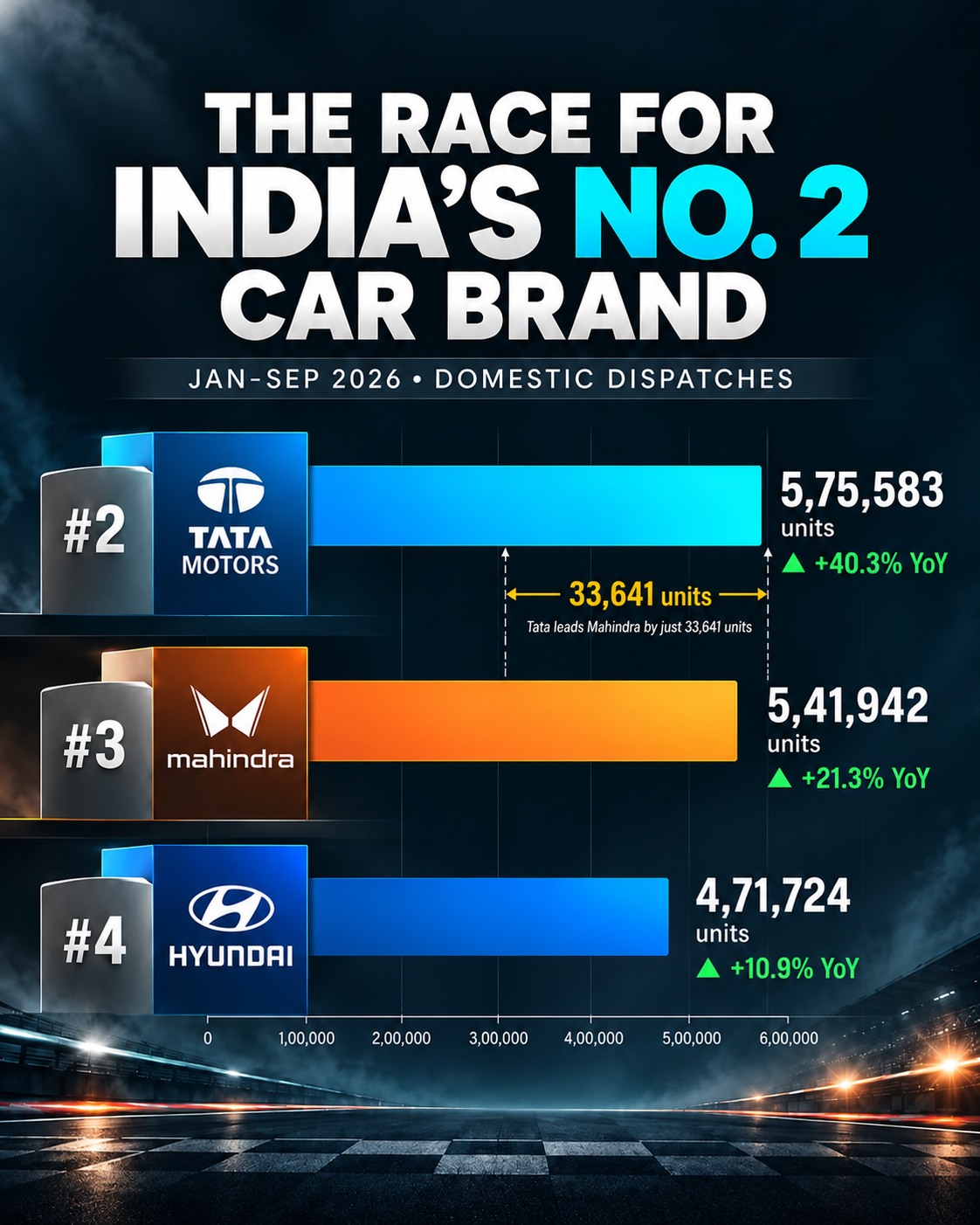
Tata Motors has moved ahead of Mahindra and Hyundai in domestic passenger vehicle dispatches for January–September 2026, recording 5.76 lakh units. Mahindra follows with 5.42 lakh units, while Hyundai stands at 4.72 lakh units. The latest numbers reflect a major shift in India’s automotive pecking order over the past 15 years.
India’s passenger vehicle industry is experiencing a closely contested race for the position of the country’s second-largest carmaker. While Maruti Suzuki continues to lead the market, Tata Motors, Mahindra and Hyundai are competing to establish themselves as the strongest challenger.
Hyundai held the second position for much of the past decade, supported by a broad product range covering hatchbacks, sedans and SUVs. However, Tata Motors’ renewed product strategy, growing electric vehicle business and successful SUVs have changed the competitive equation. Mahindra has also gained ground through a product portfolio focused on SUVs, including the Thar, Scorpio and XUV families.
Mahindra emerged as the second-largest manufacturer among these three in calendar year 2025. The latest 2026 figures, however, show Tata Motors moving back into the lead.
According to Auto Punditz’s analysis of model-wise domestic passenger vehicle dispatches, Tata Motors recorded 5,75,583 units between January and September 2026. Mahindra followed with 5,41,942 units, while Hyundai registered 4,71,724 units.
Tata has established an advantage over both rivals, but the final quarter will determine whether it can maintain this position through the end of the year.
Tata vs Mahindra vs Hyundai: Sales Performance in 2026
The first nine months of 2026 show that all three manufacturers have increased their dispatch volumes, although their growth rates vary considerably.
| Manufacturer | Jan–Sep 2026 | Jan–Sep 2025 | YoY Growth |
|---|---|---|---|
| Tata Motors | 5,75,583 | 4,10,156 | +40.3% |
| Mahindra | 5,41,942 | 4,46,697 | +21.3% |
| Hyundai | 4,71,724 | 4,25,330 | +10.9% |
Source: Auto Punditz analysis of model-wise domestic passenger vehicle dispatch data.
What the Numbers Reveal
- Tata Motors: Added 1,65,427 units over the corresponding period in 2025, achieving the highest growth rate among the three manufacturers at 40.3%.
- Mahindra: Increased dispatches by 95,245 units, representing a healthy annual improvement of 21.3%.
- Hyundai: Recorded an increase of 46,394 units, translating into 10.9% growth.
- Tata’s advantage over Mahindra: 33,641 units.
- Mahindra’s advantage over Hyundai: 70,218 units.
- Tata’s advantage over Hyundai: 1,03,859 units.
The figures illustrate how rapidly the competition has evolved. Although Hyundai continues to grow, Tata Motors and Mahindra are expanding at a faster pace, changing the relative positions of the three manufacturers.
How India’s No. 2 Car Brand Battle Has Changed Since 2011
The current contest becomes more significant when compared with the manufacturers’ historical sales performance. The ranking has shifted from Hyundai’s long-standing leadership among these three brands to Mahindra’s breakthrough in 2025 and Tata Motors’ resurgence in 2026.
Historical Annual Domestic Passenger Vehicle Sales
| Calendar Year | Tata Motors | Mahindra | Hyundai | No. 2 Among the Three |
|---|---|---|---|---|
| 2011 | 2,96,698 | 2,02,694 | 3,73,709 | Hyundai |
| 2020 | 1,70,151 | 1,36,500 | 4,23,642 | Hyundai |
| 2022 | 5,26,821 | 3,32,872 | 5,52,511 | Hyundai |
| 2023 | 5,50,871 | 4,33,001 | 6,02,078 | Hyundai |
| 2024 | 5,62,473 | 5,28,460 | 6,05,433 | Hyundai |
| 2025 | 5,78,772 | 6,25,603 | 5,71,878 | Mahindra |
Source: Auto Punditz historical dispatch database. Figures represent calendar years rather than financial years.
2011–2020: Hyundai Maintains a Clear Lead
At the beginning of the period, Hyundai held a substantial advantage over its two rivals. In 2011, it dispatched 3,73,709 passenger vehicles, compared with 2,96,698 units for Tata Motors and 2,02,694 units for Mahindra.
Hyundai benefited from a diverse passenger car lineup, including popular hatchbacks and sedans, followed by the expansion of its SUV portfolio with models such as the Creta and Venue.
Tata Motors, meanwhile, went through a prolonged period of weaker passenger vehicle sales before rebuilding its portfolio. Mahindra remained more heavily dependent on utility vehicles and SUVs.
The difference was still evident in 2020, when Hyundai recorded 4,23,642 units, comfortably ahead of both competitors.
2021–2024: Tata and Mahindra Narrow the Gap
The following years brought a major change in the market. Tata Motors strengthened its position with models such as the Nexon, Punch and Tiago, alongside the expansion of its electric vehicle range.
Mahindra also benefited from a refreshed SUV lineup. The Thar, XUV700, Scorpio-N and XUV 3XO helped the company attract customers across several SUV categories.
By 2022, Tata Motors had brought the gap with Hyundai down to just 25,690 units. Two years later, Hyundai still ranked second among the three, with 6,05,433 units in 2024. Tata Motors was close behind at 5,62,473 units, while Mahindra reached 5,28,460 units.
The three manufacturers were now competing much more closely than they had a decade earlier.
2025: Mahindra Moves Ahead of Both Rivals
Calendar year 2025 marked a turning point in the rankings. Mahindra recorded 6,25,603 domestic passenger vehicle dispatches, moving ahead of Tata Motors and Hyundai.
Tata Motors finished the year with 5,78,772 units, while Hyundai registered 5,71,878 units.
Mahindra’s achievement highlighted the growing importance of SUVs in India’s passenger vehicle market. Its concentrated SUV strategy had developed into a strong volume-generating business, allowing it to surpass manufacturers with broader product portfolios.
However, Tata Motors has regained the advantage in the first nine months of 2026, setting up another potential change in the annual rankings.
Tata Motors: Punch and Nexon Lead a Rapid Expansion
Tata Motors has delivered the strongest growth among the three manufacturers during January–September 2026. Domestic dispatches climbed from 4,10,156 units in the year-earlier period to 5,75,583 units.
The resulting 40.3% increase places Tata well ahead of Mahindra and Hyundai in terms of growth momentum.
Tata Motors’ Best-Selling Models: January–September 2026
| Model | Sales |
|---|---|
| Tata Punch | 1,82,269 |
| Tata Nexon | 1,74,524 |
| Tata Sierra | 62,574 |
| Tata Tiago | 62,512 |
| Tata Harrier | 27,915 |
The Punch and Nexon remain the foundation of Tata Motors’ domestic sales performance. Together, the two models accounted for 3,56,793 units during the first nine months of 2026, equivalent to approximately 62% of the manufacturer’s total passenger vehicle dispatches.
The Punch recorded year-on-year growth of 49.5%, while the Nexon increased its volume by 27.7%. Their contribution demonstrates the importance of Tata’s presence in the compact SUV segment.
The Tata Sierra has also become a notable contributor, with 62,574 units dispatched during the period. Its addition has expanded Tata’s SUV portfolio and provided another source of volume.
The company’s growth therefore reflects both the continued strength of its established high-volume models and the contribution of newer products. Nevertheless, the substantial share generated by the Punch and Nexon also means that these two nameplates remain particularly important to Tata’s ability to maintain its lead.
Mahindra: SUV Specialisation Remains Its Biggest Advantage
Mahindra has built its passenger vehicle business around SUVs, unlike Tata Motors and Hyundai, which also compete extensively in hatchbacks and sedans.
The strategy continues to deliver results. Mahindra dispatched 5,41,942 passenger vehicles between January and September 2026, compared with 4,46,697 units in the same period of 2025. This represents growth of 21.3%.
Mahindra’s Best-Selling Models: January–September 2026
| Model Family | Sales |
|---|---|
| Mahindra Scorpio range | 1,38,273 |
| Mahindra Thar range | 97,282 |
| Mahindra Bolero range | 85,662 |
| Mahindra XUV700/7XO | 81,538 |
| Mahindra XUV 3XO range | 79,532 |
The Scorpio range was Mahindra’s largest volume contributor, generating 1,38,273 units in the first nine months of the year. The Thar and Bolero also contributed significantly, while the XUV700/7XO and XUV 3XO strengthened the company’s reach across different SUV price brackets.
These five model families together accounted for approximately 4.82 lakh units, or nearly 89% of Mahindra’s passenger vehicle dispatches.
Mahindra has also been expanding its electric SUV portfolio with models such as the BE 6, XEV 9e and XEV 9S. Its SUV-focused approach provides exposure to a segment that has become increasingly important to Indian car buyers.
The challenge for Mahindra is to translate its strong portfolio into sufficient additional volume during the final quarter. With Tata Motors growing faster in 2026, Mahindra will need to close the existing 33,641-unit gap to regain the lead among the three manufacturers.
Hyundai: Still Growing, but Losing Relative Ground
Hyundai’s fall in the rankings should not be mistaken for a decline in absolute sales. The manufacturer recorded 4,71,724 domestic passenger vehicle dispatches between January and September 2026, up 10.9% from 4,25,330 units in the corresponding period last year.
The issue is that its competitors have grown considerably faster. Tata Motors expanded by 40.3%, while Mahindra recorded 21.3% growth.
Hyundai’s Best-Selling Models: January–September 2026
| Model | Sales |
|---|---|
| Hyundai Creta | 1,43,424 |
| Hyundai Venue | 1,02,890 |
| Hyundai Exter | 62,455 |
| Hyundai Aura | 57,047 |
| Hyundai i20 | 46,673 |
The Creta remains Hyundai’s largest individual volume contributor, with 1,43,424 units dispatched during the period. The Venue followed with 1,02,890 units.
Together, the two SUVs accounted for approximately 52.2% of Hyundai’s total domestic passenger vehicle dispatches, demonstrating the importance of the company’s SUV portfolio.
However, the Creta’s cumulative sales declined by 5.8% compared with the corresponding period in 2025, while the Venue recorded 26% growth. The Exter, Aura and i20 also registered year-on-year increases.
Hyundai continues to compete across several passenger vehicle segments, but accelerating overall growth is becoming increasingly important as Tata Motors and Mahindra strengthen their positions.
Market Share: Tata Gains the Most Among the Three
The sales comparison also reveals how the competitive balance has changed. Tata Motors has increased its share of the domestic passenger vehicle market, while Hyundai has surrendered some ground to faster-growing competitors.
Market Share Comparison
| Manufacturer | Jan–Sep 2026 | Jan–Sep 2025 | Change |
|---|---|---|---|
| Tata Motors | 14.54% | 12.65% | +1.89 percentage points |
| Mahindra | 13.69% | 13.78% | -0.09 percentage points |
| Hyundai | 11.92% | 13.12% | -1.20 percentage points |
Market shares are calculated against total domestic passenger vehicle volumes represented in the Auto Punditz dataset.
Tata Motors recorded the largest market-share improvement among the three manufacturers, adding approximately 1.89 percentage points over the year-earlier period.
Mahindra’s share remained broadly stable, slipping by just 0.09 percentage points. Hyundai, however, lost around 1.20 percentage points.
This highlights an important distinction in automotive sales analysis: higher absolute sales do not necessarily translate into a higher market share. A manufacturer can increase its dispatches while losing share if the wider market or its competitors expand at a faster rate.
For Hyundai, the immediate concern is therefore not simply increasing volumes, but doing so quickly enough to remain competitive in a market where Tata Motors and Mahindra are gaining momentum.
September 2026 Sales: Tata Continues to Lead
The latest monthly figures support Tata Motors’ position in the cumulative rankings. It remained ahead of Mahindra and Hyundai in September 2026.
| Manufacturer | September 2026 Dispatches | YoY Growth |
|---|---|---|
| Tata Motors | 68,810 | +15.3% |
| Mahindra | 64,092 | +14.0% |
| Hyundai | 57,166 | +10.9% |
Tata Motors finished the month 4,718 units ahead of Mahindra and 11,644 units ahead of Hyundai.
According to the model-wise dispatch data, Tata also led both competitors in each month from January through September 2026. This consistency has helped the company establish its current advantage in the year-to-date standings.
It is worth noting that wholesale dispatches and retail registrations measure different stages of vehicle sales. Differences in dealer inventory and registration timing can therefore produce a different ranking when retail data is considered.
Can Mahindra Regain Second Place in the Final Quarter?
With October, November and December remaining, the contest is not yet decided. Tata Motors currently holds a 33,641-unit lead over Mahindra, leaving the latter with a significant but measurable gap to overcome.
To finish ahead of Tata, Mahindra would need to dispatch at least 33,642 more passenger vehicles than Tata during the final three months of 2026. That translates to an average monthly advantage of approximately 11,214 units.
Hyundai faces a steeper challenge. It trails Mahindra by 70,218 units and Tata Motors by 1,03,859 units, meaning a substantial change in relative performance would be required for it to move ahead of either rival.
The final quarter will be influenced by festive-season demand, production capacity, model availability and how manufacturers manage dealer inventories. Sustaining the current pace of growth will be particularly important for Tata, while Mahindra will need to outperform its rival consistently to close the gap.
Hyundai, meanwhile, will need stronger volume growth to reduce the distance between itself and the two manufacturers ahead of it.
Final Verdict: Tata Has the Momentum, but the Race Is Not Over
The contest between Tata Motors, Mahindra and Hyundai reflects a significant transformation in India’s passenger vehicle industry over the past 15 years.
Hyundai’s long-standing position has been challenged by Tata Motors’ product revival and Mahindra’s SUV-led expansion. Mahindra’s second-place finish in 2025 demonstrated the strength of its strategy, but Tata Motors has responded with the highest growth rate among the three manufacturers in 2026.
With 5,75,583 units dispatched during January–September, Tata currently leads Mahindra by 33,641 units and Hyundai by more than one lakh units. Its strong performance from the Punch, Nexon and newer models has provided considerable momentum.
Mahindra remains a serious challenger because of its sizeable SUV portfolio, while Hyundai continues to record growth despite losing market share.
The October–December quarter will determine whether Tata Motors can hold on to second place for the full calendar year or Mahindra can stage another comeback. What is already clear is that the competition between these three manufacturers has become one of the most closely watched rivalries in India’s passenger vehicle market.


