


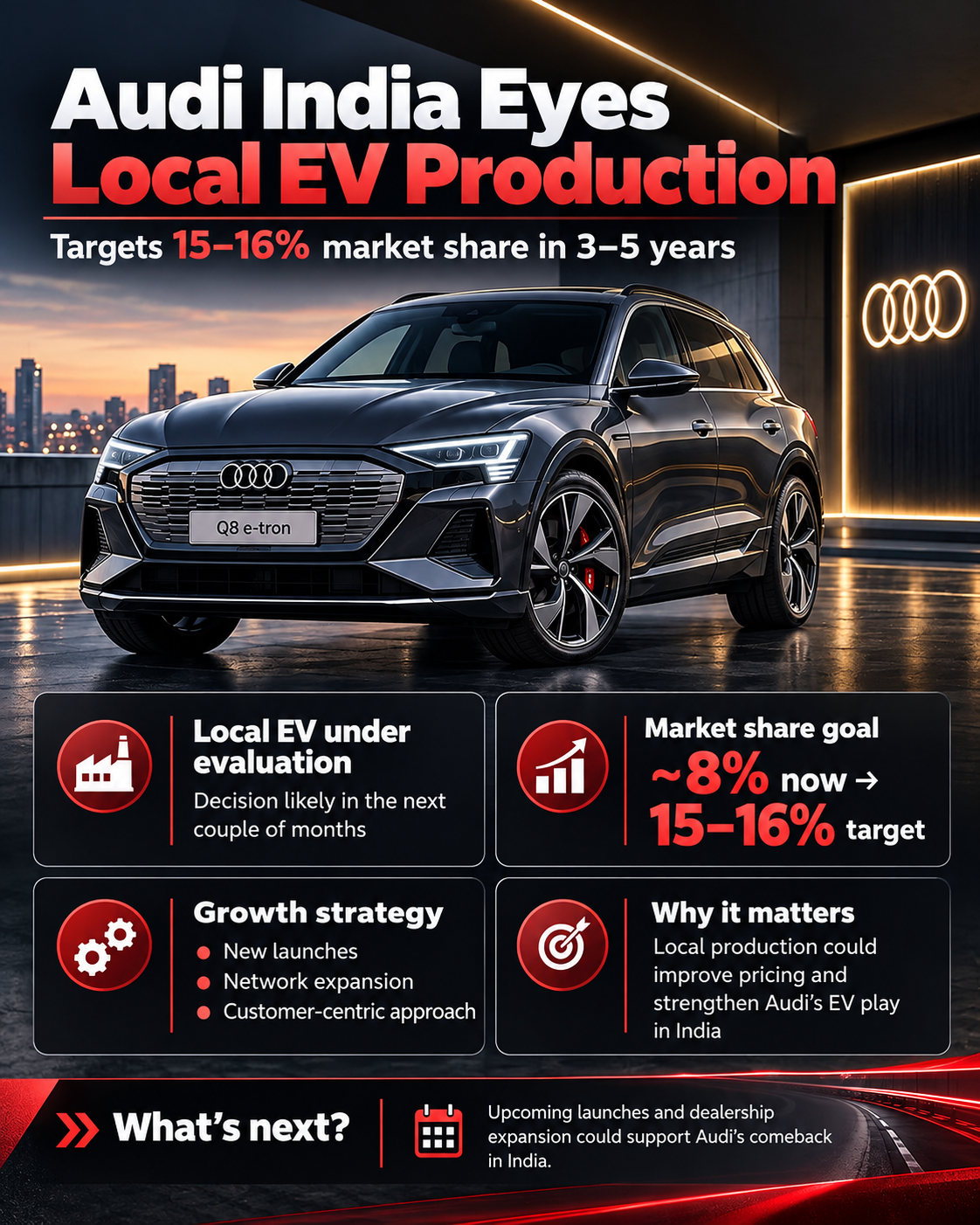
Audi is exploring the possibility of manufacturing an electric vehicle in India as part of its plans to strengthen its presence in the country’s luxury automobile segment. The German carmaker aims to increase its market share from around 8% to 15–16% over the next three to five years, supported by product launches, greater localisation and an expanded retail network.
Audi India Brand Director Balbir Singh Dhillon has indicated that the company is assessing the business case for domestic production of a battery-electric vehicle (BEV). A decision is expected within the next couple of months, although the manufacturer has not revealed the model under consideration.
The proposed move could help Audi address the cost challenges associated with importing fully built electric cars into India. Alongside localisation, the company plans to strengthen customer relationships, introduce new vehicles and expand its presence in emerging luxury car markets beyond major metropolitan areas.
Domestic EV Manufacturing Could Reshape Audi’s India Strategy
Manufacturing an electric car locally could give Audi greater flexibility in positioning its future EVs for Indian customers. Fully imported luxury vehicles typically attract substantial import duties, which can push their retail prices considerably higher.
Local production or assembly could help the company manage these costs and improve the commercial prospects of its electric vehicle range. However, the financial benefits would depend on the level of domestic sourcing, manufacturing arrangements and production volumes.
Audi has not yet confirmed which EV could be selected for Indian production. Details regarding the investment amount, manufacturing capacity, localisation targets and potential launch date also remain undisclosed.
The company’s experience in the Indian luxury EV segment has highlighted the pricing challenges associated with importing vehicles in fully built form. A domestic manufacturing strategy could therefore become an important consideration as Audi develops its longer-term electrification plans.
Audi’s Growth Targets at a Glance
Audi’s proposed localisation strategy is part of a wider effort to regain ground in India’s competitive premium car market.
| Parameter | Current plan or position |
|---|---|
| Estimated current market share | Around 8% |
| Target market share | 15–16% |
| Target period | Next 3–5 years |
| Electric vehicle strategy | Assessing local production |
| Main growth priorities | New models, localisation and dealership expansion |
| Key competitors | Mercedes-Benz, BMW and Jaguar Land Rover |
Achieving this target will require Audi to strengthen several areas of its business rather than relying on new vehicle launches alone.
Three Priorities Behind Audi’s Expansion Plans
1. Improving the Customer Ownership Experience
Audi plans to place greater emphasis on customer satisfaction, aftersales support and engagement throughout the ownership journey.
In the luxury car segment, buyers evaluate more than the vehicle itself. Service quality, convenience, reliability and long-term ownership costs can significantly influence purchasing decisions and brand loyalty.
Improving these areas could help Audi retain existing customers while encouraging repeat purchases and recommendations.
2. Bringing New Models to the Market
Refreshing its product portfolio will be another important part of Audi’s strategy. New-generation vehicles across different categories could help the brand compete more effectively with Mercedes-Benz and BMW.
Luxury SUVs are particularly important because of their popularity among premium car buyers. At the same time, updating its sedan range and expanding its flagship offerings could help Audi appeal to a broader audience.
3. Reaching More Customers Through Dealership Expansion
Audi is also looking to strengthen its retail presence outside India’s largest cities. Growing demand for premium vehicles in Tier-II and Tier-III markets presents an opportunity to reach customers who may not currently have convenient access to an authorised dealership.
A larger network could improve vehicle sales, aftersales accessibility and overall brand visibility in these markets.
Upcoming Audi Models That Could Strengthen Its Portfolio
Audi’s future product pipeline could play a significant role in its efforts to improve sales and regain market share in India.
Based on previously reported plans, the potential arrivals include the following models:
| Model | Indicative India timeline |
|---|---|
| New-generation Audi Q3 | Q4 2026 |
| New-generation Audi A5 | First half of 2027 |
| Audi Q9 flagship SUV | Second half of 2027, subject to final plans |
| Locally produced Audi EV | Under evaluation; launch date not confirmed |
Note: These timelines are indicative and may change. They should not be treated as confirmed launch announcements.
The next-generation Q3 could be particularly important for Audi in the entry-level luxury SUV category, where competition for customers remains intense.
The A5 could help update the brand’s sedan portfolio, while the Q9 may offer a new option in the full-size luxury SUV segment if its India introduction proceeds as expected.
Together with other product updates, these vehicles could support Audi’s efforts to improve its market position from 2027 onwards.
Could the India-EU Trade Agreement Benefit Audi?
Developments surrounding the proposed India-European Union Free Trade Agreement (FTA) could also influence Audi’s future product strategy.
If the agreement reduces import duties for eligible European vehicles, luxury carmakers may find it easier to introduce selected imported models at more competitive prices. The actual impact, however, will depend on the agreement’s final terms, eligibility conditions and implementation.
For Audi, more favourable import conditions could create opportunities to introduce additional vehicles and assess their potential among Indian buyers before making a decision on local manufacturing.
The company could potentially adopt a combination of two approaches:
- Domestic manufacturing: Produce or assemble core models in India, particularly where demand and production economics support localisation.
- Vehicle imports: Bring in additional models to broaden the portfolio and evaluate customer interest before considering domestic production.
Such a strategy could provide greater flexibility in managing product costs and responding to changing demand. Any wider benefits for India’s automotive component industry would depend on the final trade framework and the extent of local manufacturing activity.
Audi Wants to Expand Its Reach Beyond Major Cities
Strengthening its dealership network is another key component of Audi India’s growth ambitions.
The company had previously outlined plans to increase its dealership count from approximately 29 to around 40 by the end of 2027. The proposed expansion is expected to include a greater focus on Tier-II and Tier-III cities.
Rising incomes, infrastructure improvements and growing interest in premium vehicles are creating opportunities for luxury carmakers in markets beyond traditional metropolitan centres.
A stronger retail network could make it easier for prospective customers to explore Audi vehicles, complete purchases and access authorised servicing closer to home.
For existing owners, improved service accessibility could also contribute to a more convenient ownership experience. This would be particularly relevant as Audi seeks to improve customer retention and rebuild momentum in India.
Sales Performance Shows the Scale of the Challenge
Audi’s proposed growth strategy comes against the backdrop of a difficult sales environment in India.
According to the company figures cited in earlier reports, Audi sold approximately 4,510 vehicles during 2025. Its deliveries totalled 1,896 units in the first half of 2026.
Meanwhile, India’s luxury passenger vehicle market was estimated at approximately 52,000 units in 2025, with further expansion expected.
These figures point to an opportunity for Audi, but capturing a larger share of the market will not be straightforward. Mercedes-Benz, BMW and Jaguar Land Rover remain significant competitors, with established portfolios and ongoing efforts to strengthen their customer reach.
To move closer to its 15–16% market-share target, Audi will need to improve the competitiveness of its products, maintain a consistent launch schedule, ensure adequate vehicle availability and expand its retail presence.
Local manufacturing could contribute to this effort, but its impact will depend on the model selected and the commercial benefits the company can achieve.
What Local EV Production Could Mean for Audi
Domestic electric vehicle production could support Audi’s long-term ambitions in several ways.
| Strategic area | Potential impact |
|---|---|
| Pricing | Lower dependence on fully built vehicle imports could improve cost flexibility |
| Market competitiveness | More competitive positioning against rival luxury EVs |
| Supply and availability | Greater flexibility in responding to customer demand |
| Supplier ecosystem | Opportunities to work with Indian component manufacturers |
| Long-term presence | Stronger commitment to India’s premium electric vehicle market |
| Customer reach | Potential to make selected luxury EVs accessible to a wider buyer base |
These benefits are potential outcomes rather than guaranteed results. The final cost advantage would depend on the manufacturing model, the proportion of locally sourced components, production scale and investment requirements.
Assembling imported kits in India may offer different savings compared with manufacturing vehicles using a higher proportion of locally sourced parts. Audi would need to assess these factors before committing to a production programme.
The product itself will also remain critical. Future electric models must deliver competitive range, charging capabilities, performance, technology and reliability, backed by suitable service and customer support.
Competition in India’s Luxury EV Market Is Intensifying
India’s premium electric vehicle market is attracting growing attention from established luxury manufacturers and other EV brands.
Mercedes-Benz, BMW, Volvo and other premium players have been developing their electric vehicle portfolios, giving customers more options across different price points and body styles.
Audi’s consideration of local manufacturing comes at a time when pricing, product features and ownership experience are becoming increasingly important to the segment’s growth.
However, luxury EV buyers typically expect a comprehensive package that includes performance, premium interiors, advanced technology, brand appeal and dependable aftersales support. A lower price alone may not be enough to convince customers to choose one brand over another.
Audi will therefore need to combine a competitive product offering with a strong ownership proposition if it wants to convert its expansion plans into sustained sales growth.
Conclusion
Audi India’s proposal to evaluate local electric vehicle production represents one part of a broader plan to strengthen its position in the country’s luxury automobile market.
The company aims to raise its estimated market share from around 8% to 15–16% over the next three to five years, with new-generation vehicles, dealership expansion and a stronger focus on customers supporting the effort.
A decision on local EV production is expected within the next couple of months, but the model, investment, manufacturing details and launch schedule have not been confirmed.
The success of Audi’s strategy will ultimately depend on how effectively it combines product launches, competitive pricing, localisation and customer experience. If these initiatives deliver the intended results, they could help the German carmaker build a stronger position in India’s increasingly competitive luxury car and electric mobility markets.


