


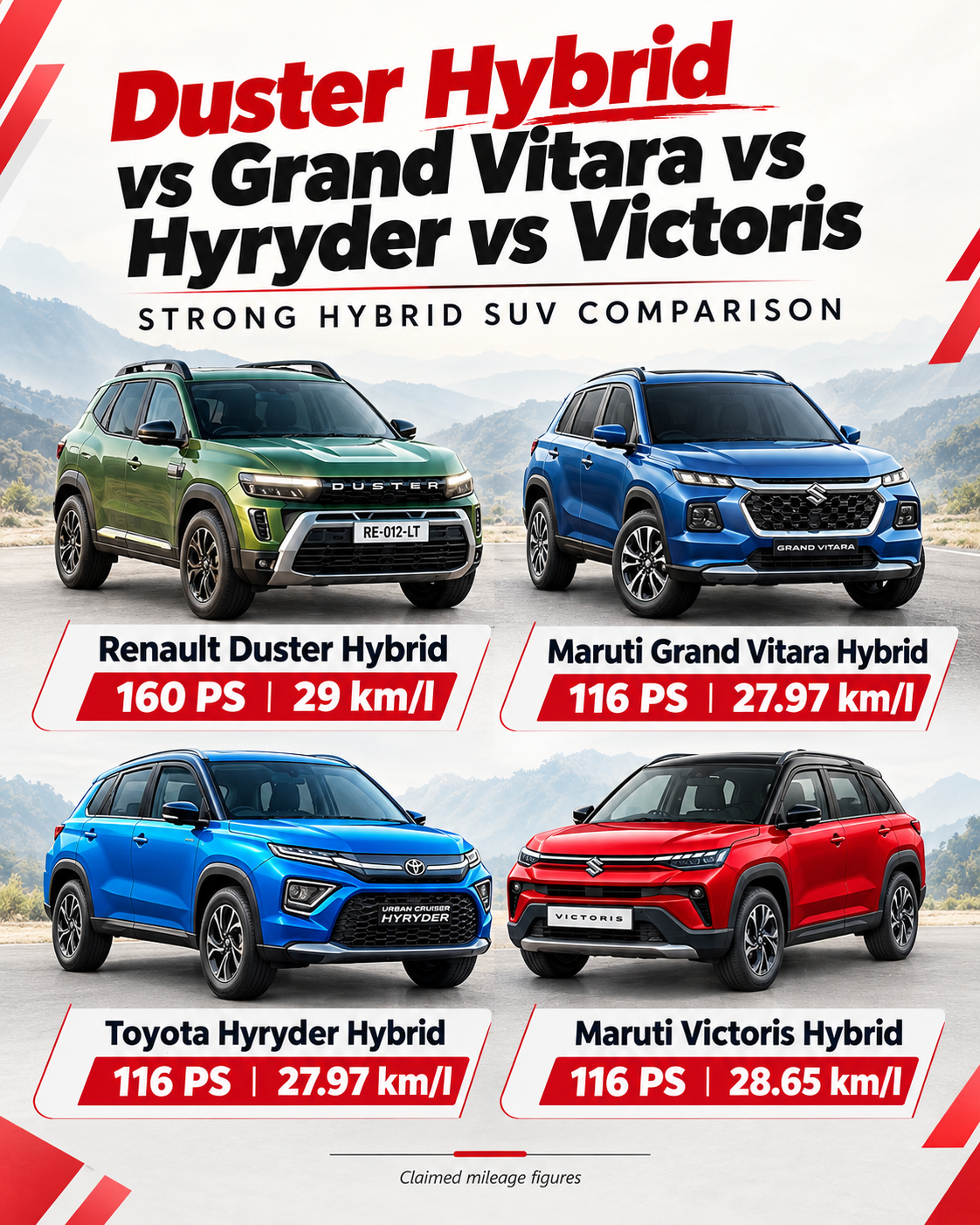
Renault has stepped up the competition in India’s midsize SUV segment with the introduction of the Duster Strong Hybrid E-Tech 160, priced at ₹16.99 lakh. Offering 160 PS of combined power and a claimed fuel economy of 29 km/l, the new hybrid SUV takes on established competitors, including the Maruti Suzuki Grand Vitara, Toyota Urban Cruiser Hyryder and Maruti Suzuki Victoris.
While all four models use self-charging strong-hybrid technology, their specifications, pricing and overall appeal differ. The Duster stands out with its higher power output, whereas the Maruti and Toyota offerings focus on a balance of fuel economy, everyday usability and established hybrid technology.
Strong Hybrid SUVs: Specifications at a Glance
| Specification | Renault Duster | Maruti Grand Vitara | Toyota Hyryder | Maruti Victoris |
|---|---|---|---|---|
| Petrol engine | 1.8-litre, 4-cylinder | 1.5-litre, 3-cylinder | 1.5-litre, 3-cylinder | 1.5-litre, 3-cylinder |
| Combined power | 160 PS | 116 PS | 116 PS | 116 PS |
| Claimed fuel efficiency | 29.0 km/l | 27.97 km/l | 27.97 km/l | 28.65 km/l |
| Transmission | Multi-mode hybrid automatic | e-CVT | e-CVT | e-CVT |
| Drivetrain | FWD | FWD | FWD | FWD |
Note: Fuel efficiency figures are manufacturer-claimed and may differ from actual driving results. All four SUVs feature self-charging strong-hybrid systems and do not require external charging.
Fuel Efficiency: Duster Takes the Lead on Paper
The Renault Duster currently has the highest claimed fuel efficiency among these four strong-hybrid SUVs, with a rated figure of 29 km/l. The Maruti Suzuki Victoris follows closely at 28.65 km/l, while the Grand Vitara and Toyota Hyryder share a claimed mileage figure of 27.97 km/l.
Claimed mileage comparison
| Rank | SUV | Claimed Mileage |
|---|---|---|
| 1 | Renault Duster | 29.0 km/l |
| 2 | Maruti Suzuki Victoris | 28.65 km/l |
| 3 | Maruti Suzuki Grand Vitara | 27.97 km/l |
| 3 | Toyota Urban Cruiser Hyryder | 27.97 km/l |
The difference between the Duster and Victoris is relatively small, at just 0.35 km/l. However, the Duster’s claimed figure places it at the top of this comparison.
It is worth noting that official fuel economy figures do not necessarily translate into the same results on Indian roads. Traffic conditions, driving style, road surfaces and air-conditioning usage can all influence actual fuel consumption. Independent real-world tests will provide a clearer picture of how these SUVs compare in everyday conditions.
Strong Hybrid SUV Prices Compared
The starting prices of the four models are relatively close, making the decision dependent on more than just the initial purchase cost.
| SUV | Starting Strong Hybrid Price |
|---|---|
| Maruti Suzuki Victoris | ₹16.43 lakh |
| Maruti Suzuki Grand Vitara | ₹16.68 lakh |
| Renault Duster | ₹16.99 lakh |
| Toyota Urban Cruiser Hyryder | Approximately ₹17.18 lakh |
Prices are ex-showroom figures for October 2026, with introductory pricing applicable where specified. Prices and availability may vary.
The Maruti Suzuki Victoris has the lowest listed entry price at ₹16.43 lakh, followed by the Grand Vitara at ₹16.68 lakh. The Renault Duster is priced at ₹16.99 lakh, while the Toyota Hyryder’s strong-hybrid range starts at approximately ₹17.18 lakh.
The Duster therefore costs more than the two Maruti options at the entry level but is priced below the Hyryder based on the figures listed here. Buyers should also compare the equipment offered in the specific variants, as starting prices alone do not establish which SUV provides the best overall value.
Performance: Renault Duster Offers More Power
One of the biggest differences between these SUVs is their combined power output. The Renault Duster Strong Hybrid E-Tech 160 produces 160 PS, substantially higher than the 116 PS offered by the Grand Vitara, Hyryder and Victoris strong-hybrid versions.
This gives the Duster a numerical advantage of 44 PS, or approximately 38% more power than its three rivals.
The larger 1.8-litre, four-cylinder petrol engine distinguishes the Duster from the three Maruti-Toyota models, which use 1.5-litre, three-cylinder petrol engines as part of their strong-hybrid systems. The Duster also uses a multi-mode hybrid automatic transmission, while the other three models employ e-CVT units.
For buyers looking for stronger power delivery alongside hybrid efficiency, the Duster’s specifications could make it an attractive proposition. However, the higher output does not automatically guarantee quicker acceleration, better refinement or superior driving dynamics in every situation.
Factors such as throttle response, transmission calibration, engine noise, low-speed behaviour and highway performance will need to be assessed through independent road tests before a definitive performance verdict can be reached.
The Grand Vitara, Hyryder and Victoris, meanwhile, benefit from an established Toyota-derived strong-hybrid system. Buyers who value an existing ownership track record may find this a relevant consideration when choosing between the four SUVs.
Which Strong Hybrid SUV Should You Choose?
The right option depends on your priorities, whether that means performance, purchase price, features, service accessibility or confidence in long-term ownership.
Renault Duster Strong Hybrid E-Tech 160 — For performance-oriented buyers
The Duster combines the highest claimed power output in this comparison with the best claimed fuel economy. Its 160 PS system and 29 km/l mileage figure make it an interesting choice for buyers seeking a blend of performance and efficiency.
However, its long-term hybrid reliability, after-sales experience and real-world driving performance are yet to be established through an extensive ownership record in India.
Maruti Suzuki Victoris Strong Hybrid — For value and equipment
The Victoris has the lowest listed starting price among the four SUVs and delivers a claimed mileage of 28.65 km/l. Its modern equipment and five-star Bharat NCAP safety rating add to its appeal.
For buyers who want a feature-rich hybrid SUV without choosing the most expensive entry point in this comparison, the Victoris is worth considering.
Maruti Suzuki Grand Vitara Strong Hybrid — For an established ownership proposition
The Grand Vitara combines a Toyota-derived hybrid system with Maruti Suzuki’s extensive service network. Its claimed fuel efficiency of 27.97 km/l remains competitive, while potential dealer discounts could further influence its effective purchase price.
It is a suitable option for buyers who prioritise familiarity with the hybrid system, service accessibility and overall ownership convenience.
Toyota Urban Cruiser Hyryder Strong Hybrid — For Toyota’s ownership experience
The Hyryder shares its strong-hybrid technology with the Grand Vitara and offers the same claimed fuel economy of 27.97 km/l. Buyers may prefer it based on Toyota’s dealership experience, available warranty terms and their expectations around resale value.
The final decision should also account for variant-specific features, service costs and local dealer support rather than relying on brand reputation alone.
Verdict: Which Hybrid SUV Comes Out Ahead?
The Renault Duster Strong Hybrid E-Tech 160 enters the comparison with two headline advantages: the highest combined power output at 160 PS and the highest claimed fuel efficiency at 29 km/l. These figures give it a strong starting position against the Grand Vitara, Hyryder and Victoris.
The Victoris, however, has the lowest listed entry price and a competitive mileage figure, while the Grand Vitara and Hyryder offer buyers an established hybrid system backed by their respective manufacturer networks.
Ultimately, the Duster looks promising for buyers who place performance and claimed efficiency at the top of their priorities. The Victoris could appeal to those seeking value and features, while the Grand Vitara and Hyryder remain relevant alternatives for buyers focused on ownership experience.
A final recommendation will depend on real-world fuel economy, independent performance tests, variant-level equipment, after-sales support and long-term ownership costs. Until those factors are assessed alongside the specifications, each SUV has a distinct case to make in India’s strong-hybrid market.


