


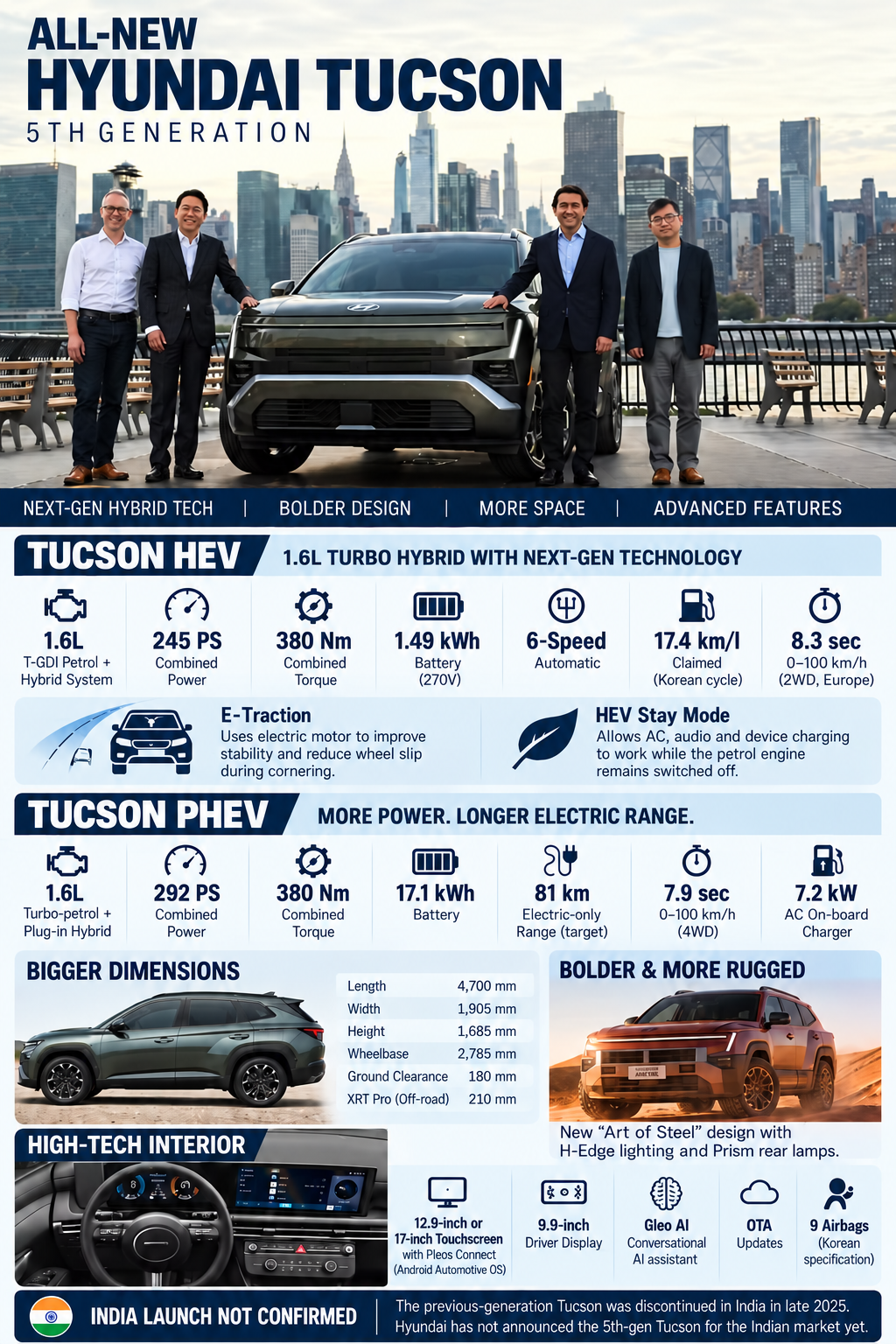
Hyundai has revealed the technical details of the fifth-generation Tucson, bringing a new-generation hybrid powertrain, increased exterior dimensions and a significantly upgraded technology package. The latest iteration of the SUV focuses on improved efficiency, enhanced driving refinement and a more connected cabin experience.
At the centre of the update is Hyundai’s next-generation hybrid technology. The European-specification Tucson Hybrid (HEV) pairs a 1.6-litre T-GDI turbocharged petrol engine with an electric motor to deliver a combined output of 245 PS and 380 Nm of torque. The system works with a six-speed automatic gearbox and a compact 1.49 kWh, 270V battery.
According to Hyundai, the hybrid SUV can achieve fuel economy of up to 17.4 km/l under the Korean test cycle. The front-wheel-drive European version completes the 0–100 km/h sprint in 8.3 seconds. Powertrain specifications and performance figures differ depending on the market.
Hyundai Tucson Hybrid: Technical Specifications
| Specification | Fifth-Generation Tucson HEV |
|---|---|
| Powertrain | 1.6-litre T-GDI petrol engine with hybrid system |
| Combined Power | Up to 245 PS |
| Combined Torque | 380 Nm |
| Battery Capacity | 1.49 kWh, 270V |
| Transmission | 6-speed automatic |
| 0–100 km/h | 8.3 seconds (European 2WD version) |
| Claimed Fuel Efficiency | Up to 17.4 km/l (Korean test cycle) |
| Drivetrain | 2WD / 4WD, depending on market |
Beyond improving fuel economy, Hyundai’s latest hybrid setup introduces functions intended to enhance vehicle control and convenience. One such feature is E-Traction, which uses electric motor torque management to help maintain stability and limit wheel slip when cornering.
The Tucson Hybrid also features HEV Stay Mode, which allows occupants to continue using selected electrical functions, including climate control, the audio system and device charging, while the petrol engine remains switched off. This creates a quieter, more electric-vehicle-like experience when the SUV is stationary.
Plug-In Hybrid Version Delivers 292 PS
Hyundai has also outlined the specifications of the fifth-generation Tucson Plug-in Hybrid (PHEV), which combines the same 1.6-litre turbocharged petrol engine with a more powerful electric drive system.
The combined output rises to 292 PS, with peak torque rated at 380 Nm. Unlike the conventional hybrid, the plug-in version uses a larger 17.1 kWh battery, enabling a targeted electric-only driving range of up to 81 km.
For charging, the PHEV is equipped with a 7.2 kW onboard AC charger. The four-wheel-drive version is claimed to accelerate from 0–100 km/h in 7.9 seconds, placing it ahead of the conventional hybrid in terms of straight-line performance.
The two electrified variants cater to different requirements, with the HEV prioritising everyday efficiency without requiring external charging, while the PHEV offers a longer electric-only driving capability.
Increased Dimensions Bring More Space
The new Tucson has grown compared with the outgoing generation, with the long-wheelbase version measuring 4,700 mm in length and 1,905 mm in width. Its overall height stands at 1,685 mm, while the wheelbase measures 2,785 mm.
The revised dimensions represent an increase of 60 mm in length, 40 mm in width and 30 mm in wheelbase over its predecessor. Hyundai has used these changes to improve the available space for passengers and luggage.
Fifth-Generation Hyundai Tucson: Dimensions
| Measurement | Long-Wheelbase Tucson |
|---|---|
| Length | 4,700 mm |
| Width | 1,905 mm |
| Height | 1,685 mm |
| Wheelbase | 2,785 mm |
| Ground Clearance | 180 mm |
| XRT Pro Ground Clearance | 210 mm |
Standard versions offer 180 mm of ground clearance, while the more adventure-oriented Tucson XRT Pro raises this figure to 210 mm. The additional clearance, along with its rugged equipment, gives the XRT Pro a stronger focus on rough-road use.
Art of Steel Design Language Introduces a More Muscular Look
Hyundai has adopted its latest “Art of Steel” design philosophy for the new Tucson. The styling moves towards a more upright stance, stronger body proportions and pronounced wheel arches, while relatively clean body surfaces give the SUV a more contemporary appearance.
At the front, the SUV features Hyundai’s new H-Edge lighting signature. The rear design incorporates distinctive Prism Rear Lamps, adding a recognisable visual element to the updated exterior.
For buyers looking for a more rugged appearance and greater capability on uneven terrain, the Tucson XRT Pro adds extra body protection and all-terrain tyres. Its 210 mm ground clearance is 30 mm higher than that of the standard version.
Together, these changes give the new Tucson a more substantial presence while differentiating the regular variants from the adventure-focused trim.
Cabin Technology Includes a 17-Inch Display and Gleo AI
The cabin receives a major technology upgrade through Hyundai’s Pleos Connect infotainment platform, which is based on Android Automotive OS.
Depending on the variant and market, the system features either a 17-inch or a 12.9-inch central touchscreen, accompanied by a slim 9.9-inch driver information display. The infotainment setup supports an integrated application ecosystem, entertainment features and over-the-air software updates.
This approach expands the vehicle’s connected features beyond conventional smartphone mirroring, giving occupants access to a broader range of integrated digital services.
Another key addition is Gleo AI, Hyundai’s artificial intelligence-powered voice assistant. It is designed to interpret conversational language and retain context during interactions, allowing users to make follow-up requests without repeating an entire command.
The updated interface and connected functions are intended to make everyday vehicle controls more intuitive while bringing the Tucson in line with the latest developments in automotive software.
Suspension, Cabin Insulation and Aerodynamics Get Attention
Hyundai has revised several mechanical and structural elements to improve ride comfort and cabin refinement. The suspension mounting points and rear underbody structure have been strengthened, while a revised suspension valve is designed to improve the control of body movements and absorb road imperfections more effectively.
Noise reduction has also been addressed through additional sound insulation, updated engine mounts and thicker door glass. These changes aim to reduce the amount of engine, wind and road noise entering the cabin.
Aerodynamic performance has improved alongside the mechanical revisions. Hyundai reports that the drag coefficient for the petrol and hybrid versions has fallen from 0.33 to 0.30.
The improvement is attributed to measures including active air flaps, aerodynamically optimised wheel designs and revised spoilers. Reducing aerodynamic resistance can contribute to improved efficiency while also supporting a quieter driving experience at higher speeds.
India Launch: Will Hyundai Bring the New Tucson to the Market?
The possibility of an Indian launch remains uncertain. Hyundai discontinued the previous-generation Tucson in India in late 2025, and the company has not yet confirmed plans to introduce the fifth-generation model in the country.
Nevertheless, the latest Tucson could be an interesting addition to Hyundai’s future product portfolio in India, particularly because of its greater emphasis on electrification. The new hybrid powertrain combines strong performance with a focus on fuel efficiency, potentially offering an alternative to conventional petrol and diesel-powered SUVs.
Hyundai is working towards a broader electrified product strategy, with hybrid technology expected to become an increasingly relevant part of its portfolio. Should the Tucson return to India, the 245 PS hybrid version could offer a distinctive positioning compared with the petrol and diesel powertrains available in the outgoing model.
However, the company has not confirmed an Indian launch date, pricing, local assembly or manufacturing plans, or the powertrain that would be offered here. The specifications announced for international markets should therefore not be treated as confirmation of the Indian-market configuration.
For now, the fifth-generation Tucson represents a substantial evolution of Hyundai’s global SUV, combining updated hybrid technology, a roomier body, a redesigned cabin and improvements aimed at comfort, efficiency and everyday usability.


