


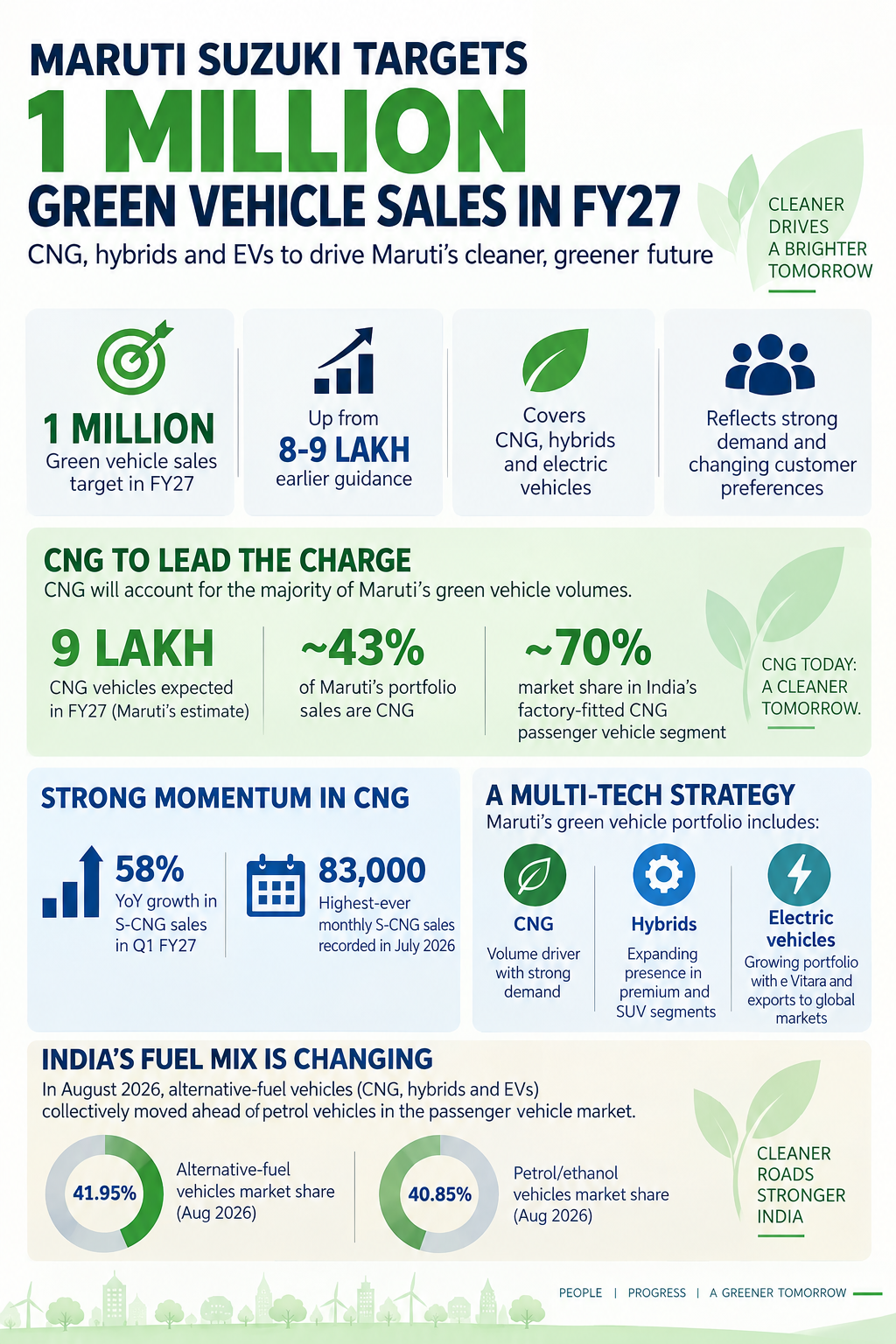
Maruti Suzuki is preparing for a significant shift towards alternative powertrains in India, with the automaker targeting nearly 10 lakh green vehicle sales in FY2026-27. The target includes its range of CNG, hybrid and electric vehicles, reflecting the growing acceptance of cleaner powertrains among Indian car buyers.
The company has also expanded its factory-fitted CNG portfolio by introducing automatic transmission options for the Swift, Dzire and Baleno as part of its newly announced Auto Green Mission.
Maruti had previously projected green vehicle sales of around 8–9 lakh units for FY27. However, the company has now raised that ambition towards the one-million-unit mark, supported by strong demand for CNG vehicles and evolving customer preferences.
CNG Expected to Drive Most of the Volumes
Although Maruti Suzuki’s green vehicle category covers CNG, hybrid and battery-electric models, CNG is expected to contribute the largest share of the targeted sales.
The automaker had earlier estimated that it could sell around 9 lakh CNG vehicles during FY27, which would represent nearly a 30% increase over the previous financial year. Maruti already has a strong position in India’s factory-fitted CNG passenger vehicle segment.
According to the company, CNG models currently contribute around 43% of its total portfolio sales, while Maruti holds approximately 70% of India’s CNG passenger vehicle market.
The company is currently selling close to 80,000 CNG cars every month, according to comments from Partho Banerjee, Senior Executive Officer, Marketing and Sales.
These numbers highlight the difference between Maruti’s approach and strategies that rely mainly on battery-electric vehicles. For the automaker, the transition towards cleaner mobility involves multiple technologies rather than a single powertrain.
Rising CNG Sales Support Maruti’s Target
CNG demand has continued to gain momentum during FY27. Maruti Suzuki reported that its S-CNG sales increased 58% year-on-year in the first quarter of the current financial year.
The momentum was particularly strong in July 2026, when the company recorded its highest-ever monthly S-CNG sales of approximately 83,000 units.
Maruti believes the CNG customer base could expand further with the introduction of automatic transmission options.
One of the limitations associated with CNG vehicles has traditionally been the relatively limited availability of automatic gearboxes. Buyers who preferred a two-pedal driving experience often had to choose petrol-powered variants instead.
The company is now attempting to address that gap.
Automatic CNG Expands to Three Popular Models
As part of the Auto Green Mission, Maruti Suzuki has introduced S-CNG variants equipped with Auto Gear Shift (AGS) on the Swift, Dzire and Baleno.
All three models combine the Z12E 1.2-litre petrol engine with a five-speed automated manual transmission and a factory-fitted CNG system.
The starting ex-showroom prices for the new automatic CNG variants are:
| Model | Automatic S-CNG Starting Price |
|---|---|
| Swift | ₹7.92 lakh |
| Baleno | ₹8.32 lakh |
| Dzire | ₹8.53 lakh |
The Dzire automatic S-CNG has a claimed fuel efficiency of 36.47 km/kg, based on certification under the applicable testing regulations.
Maruti also cites JATO Dynamics certification dated September 18, 2026, for its claim that the Dzire is India’s most fuel-efficient sedan.
The availability of automatic CNG models could be particularly relevant in urban markets, where buyers increasingly want the convenience of automatic driving while continuing to prioritise lower running costs.
Production Capacity Could Become a Limiting Factor
While demand for CNG vehicles appears strong, Maruti Suzuki’s ability to increase sales could increasingly depend on production and supply capacity.
Partho Banerjee has indicated that the company is currently dealing with capacity limitations related to CNG production. Vehicle allocation is also being managed partly based on waiting periods.
Maruti expects its CNG volumes to increase as additional production capacity becomes available.
As a result, expanding supply could become an important factor in the company’s efforts to reach its one-million-unit green vehicle sales target for FY27.
Alternative Powertrains Gain Ground in India
Maruti’s push comes as India’s passenger vehicle market continues to diversify beyond conventional petrol and diesel vehicles.
Industry data for August 2026 showed that CNG, hybrid and electric vehicles together accounted for a larger share of passenger vehicle sales than conventional petrol vehicles during the month.
Alternative-fuel vehicles accounted for approximately 41.95% of passenger vehicle sales, compared with around 40.85% for petrol/ethanol-powered vehicles.
Within the alternative-fuel category:
- CNG: 25.28%
- Hybrid: 9.04%
- EV: 7.63%
A single month’s figures do not necessarily establish a long-term market trend, but the data does highlight the increasing variety of powertrains available to Indian car buyers.
Maruti’s Green Strategy Covers Multiple Technologies
Maruti Suzuki is pursuing a broader approach to lower-emission mobility instead of relying exclusively on electric vehicles.
Its technology mix currently spans CNG, strong hybrid systems and battery-electric vehicles, with the company also exploring flex-fuel and other alternative technologies.
The e Vitara represents Maruti Suzuki’s entry into the battery-electric passenger vehicle space. The model is also being manufactured in India for international markets, with the company stating that e Vitara exports reached 44 countries during FY2025-26.
Hybrid technology continues to form part of Maruti’s strategy, particularly across its premium and SUV offerings, while CNG remains the key technology for achieving higher volumes in the mass-market segment.
CNG, Hybrid And EVs Form the Core of Maruti’s FY27 Plan
Maruti Suzuki’s decision to raise its FY27 green vehicle target to nearly 10 lakh units reflects the company’s expectation that alternative powertrains will account for an increasingly important portion of India’s passenger vehicle market.
CNG is expected to contribute the majority of these volumes, with automatic CNG models potentially opening the technology to a wider group of urban buyers. At the same time, hybrid models and the company’s growing EV presence provide additional routes towards cleaner mobility.
With demand increasing and production capacity being expanded, the combination of CNG, hybrids and EVs will be central to Maruti Suzuki’s strategy for reaching its FY27 green vehicle target.


