


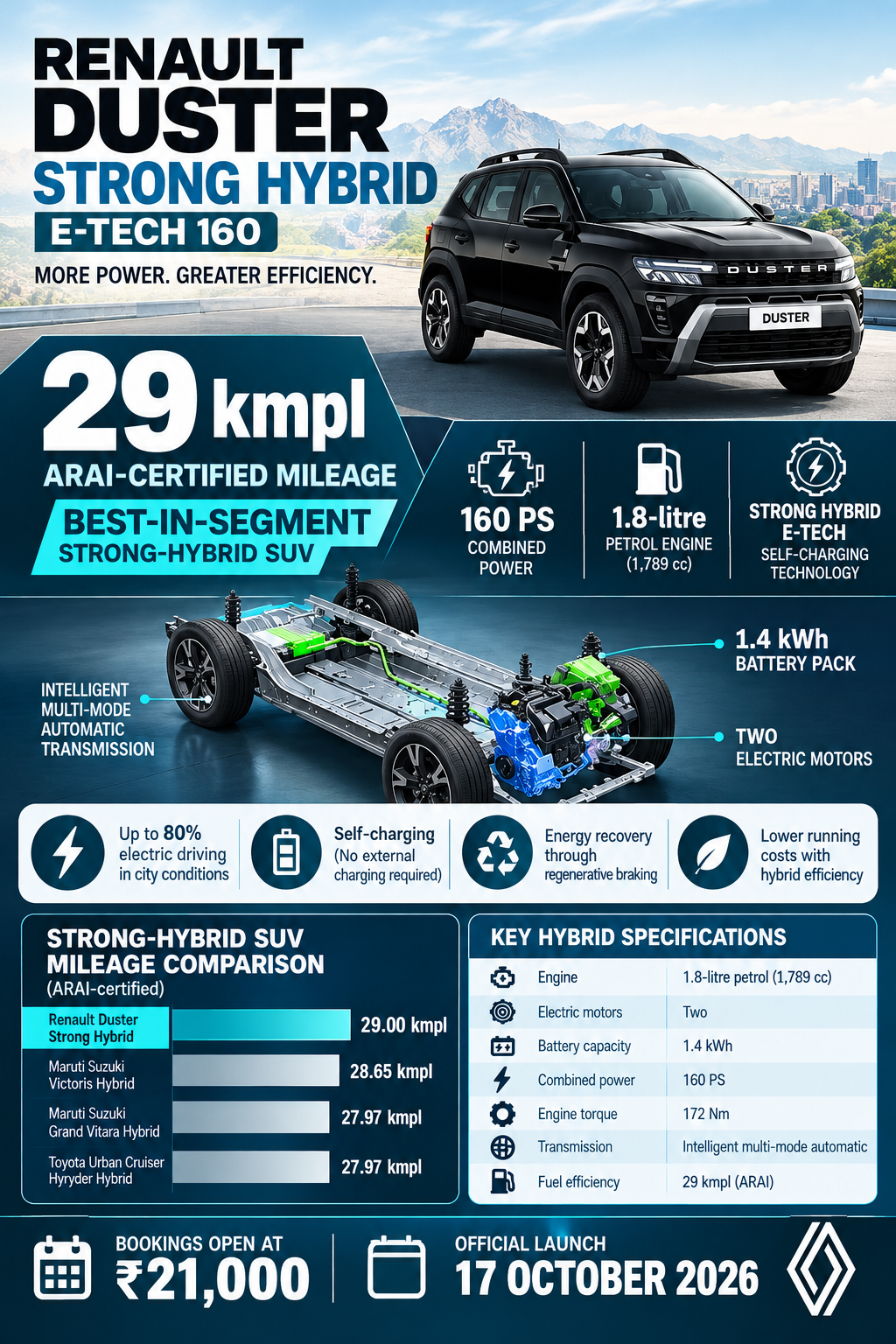
The new hybrid variant combines a 1.8-litre petrol engine with two electric motors and a 1.4 kWh battery. The powertrain produces a combined output of 160 PS and is designed to deliver a blend of fuel economy and performance without requiring external battery charging.
With this setup, Renault aims to appeal to customers looking for the efficiency associated with diesel SUVs while retaining the convenience of a petrol-powered vehicle equipped with self-charging hybrid technology.
Renault Duster Hybrid Mileage: How It Compares with Rivals
The Duster Strong Hybrid’s headline feature is its certified fuel efficiency of 29 kmpl. According to the figures provided, this gives it a small advantage over other strong-hybrid SUVs currently competing in the Indian market.
Strong-Hybrid SUV Mileage Comparison
| Model | ARAI-Certified Mileage |
|---|---|
| Renault Duster Strong Hybrid | 29.00 kmpl |
| Maruti Suzuki Victoris Hybrid | 28.65 kmpl |
| Maruti Suzuki Grand Vitara Hybrid | 27.97 kmpl |
| Toyota Urban Cruiser Hyryder Hybrid | 27.97 kmpl |
The Renault Duster leads the Maruti Suzuki Victoris by 0.35 kmpl, while its advantage over the Grand Vitara and Urban Cruiser Hyryder stands at 1.03 kmpl.
Although the differences are relatively modest, Renault’s claimed mileage is notable alongside the Duster’s higher combined power output of 160 PS. This gives the SUV a potentially compelling combination of efficiency and performance on paper.
However, certified fuel economy figures may differ from real-world results. Actual mileage will depend on factors such as traffic conditions, road type, driving habits and vehicle load.
Renault Duster Strong Hybrid E-Tech 160: Engine and Technical Details
The new Duster brings Renault’s E-Tech strong-hybrid system to its Indian lineup. Unlike a conventional mild-hybrid setup, this system can drive the vehicle using electric power alone under appropriate operating conditions.
Engine and Powertrain Specifications
| Specification | Details |
|---|---|
| Engine | 1.8-litre, four-cylinder petrol |
| Engine displacement | 1,789 cc |
| Hybrid technology | Strong Hybrid E-Tech |
| Electric motors | Two |
| Battery capacity | 1.4 kWh |
| Combined power output | 160 PS |
| Petrol engine torque | 172 Nm |
| Transmission | Intelligent multi-mode automatic |
| Certified fuel efficiency | 29 kmpl |
| External charging | Not required |
The hybrid system uses two electric motors that perform different roles within the powertrain. One supports electricity generation, while the other contributes directly to driving the wheels.
An intelligent multi-mode automatic transmission coordinates the petrol engine and electric motors, adjusting their operation according to driving requirements. This arrangement is intended to improve efficiency while delivering power when the driver needs it.
Electric Driving Capability in Urban Conditions
Renault says the Duster Strong Hybrid can operate in electric mode for up to 80% of the time during city driving under suitable conditions. This capability is particularly relevant in urban environments, where frequent stops and low-speed movement can create opportunities for electric propulsion.
The hybrid system is designed to perform several functions:
- Start the vehicle using electric power.
- Drive in electric-only mode when speed and operating conditions permit.
- Combine petrol-engine and electric-motor power when greater acceleration is required.
- Recover energy during braking and deceleration.
- Recharge the battery automatically without a charging station.
Regenerative braking helps recover energy that would otherwise be lost during deceleration. The petrol engine can also contribute to battery charging when required.
Unlike a battery-electric vehicle or a plug-in hybrid, the Duster Strong Hybrid does not need to be connected to an external power source. This makes it suitable for buyers who want some of the benefits of electric propulsion without changing their refuelling routine.
The claimed electric-driving proportion will depend on operating conditions and should not be interpreted as a fixed percentage for every journey.
Renault Wants to Attract Diesel SUV Customers
Fuel efficiency has traditionally been one of the major reasons buyers choose diesel-powered SUVs, especially when their vehicles cover substantial distances every month. Renault is looking to appeal to this customer group with the Duster Strong Hybrid’s combination of a 29 kmpl certified mileage figure and a 160 PS combined output.
Strong-hybrid petrol technology offers an alternative for customers who want to reduce fuel consumption without opting for a diesel engine. Electric assistance can be particularly useful in stop-and-go traffic, while the petrol engine provides flexibility for longer journeys.
The Duster’s hybrid variant will expand the model’s powertrain portfolio alongside its turbo-petrol options. This gives buyers additional flexibility when choosing a vehicle based on their driving patterns and performance requirements.
Whether the hybrid proves more economical than a diesel alternative in actual ownership will depend on factors such as purchase price, fuel costs, annual running and maintenance expenses.
Renault Duster Strong Hybrid: Booking Amount, Launch Date and Other Details
Renault has opened bookings for the Duster Strong Hybrid E-Tech 160 ahead of its official launch in India.
| Particulars | Details |
|---|---|
| Model | Renault Duster Strong Hybrid E-Tech 160 |
| Booking status | Open |
| Booking amount | ₹21,000 |
| Official launch date | October 17, 2026 |
| Final price | Expected to be announced at launch |
| Hybrid variant pricing | Not yet announced |
| Booking channels | Renault India website and authorised dealerships |
| Delivery schedule | Yet to be confirmed |
| ARAI-certified mileage | 29 kmpl |
| Combined power output | 160 PS |
Interested buyers can place their bookings through Renault India’s official website or at authorised dealerships. Pricing, detailed variant information and delivery timelines are expected to be clarified around the launch.
The ₹21,000 booking amount allows prospective customers to register their interest before the final pricing announcement. Buyers should check the applicable booking terms and conditions with Renault before proceeding.
Stronger Competition in India’s Hybrid SUV Segment
The arrival of the Duster Strong Hybrid adds another option to India’s increasingly competitive midsize SUV market. Buyers can already choose from petrol, turbo-petrol, diesel and strong-hybrid offerings, with Maruti Suzuki and Toyota maintaining an established presence in the hybrid category.
The Maruti Suzuki Grand Vitara, Maruti Suzuki Victoris and Toyota Urban Cruiser Hyryder are among the key rivals the new Renault will face.
The Duster takes a different technical approach, combining a larger 1.8-litre petrol engine with two electric motors, a 1.4 kWh battery and an intelligent multi-mode transmission. By comparison, the strong-hybrid versions of the Grand Vitara and Hyryder use 1.5-litre petrol engines paired with e-CVT transmissions.
This difference in powertrain configuration gives Renault another way to distinguish the Duster in a segment where fuel economy, driving performance and ownership costs are important purchase considerations.
With bookings now open and the launch approaching, the final pricing will be a crucial factor in determining how competitive the Duster Strong Hybrid is against its established rivals.
Conclusion
The Renault Duster Strong Hybrid E-Tech 160 brings a claimed 29 kmpl fuel efficiency figure, a 160 PS combined output and a self-charging hybrid system to India’s midsize SUV segment. Its certified mileage places it ahead of the listed Grand Vitara, Hyryder and Victoris hybrid figures, while its larger engine and multi-mode transmission provide a distinct powertrain proposition.
Bookings have commenced at ₹21,000 ahead of the October 17, 2026 launch. With prices and delivery details still to be announced, the Duster’s eventual market positioning will depend on its pricing, variant availability and real-world ownership costs.


