


India’s electric scooter market is entering a new phase. Instead of competing only in the premium segment, manufacturers are increasingly trying to bring EVs within reach of mainstream commuters.
The latest battle is between Ola Electric’s S1Z and Ather Energy’s Konarc. Both target price-conscious buyers, but the companies have taken noticeably different routes to achieve that goal.
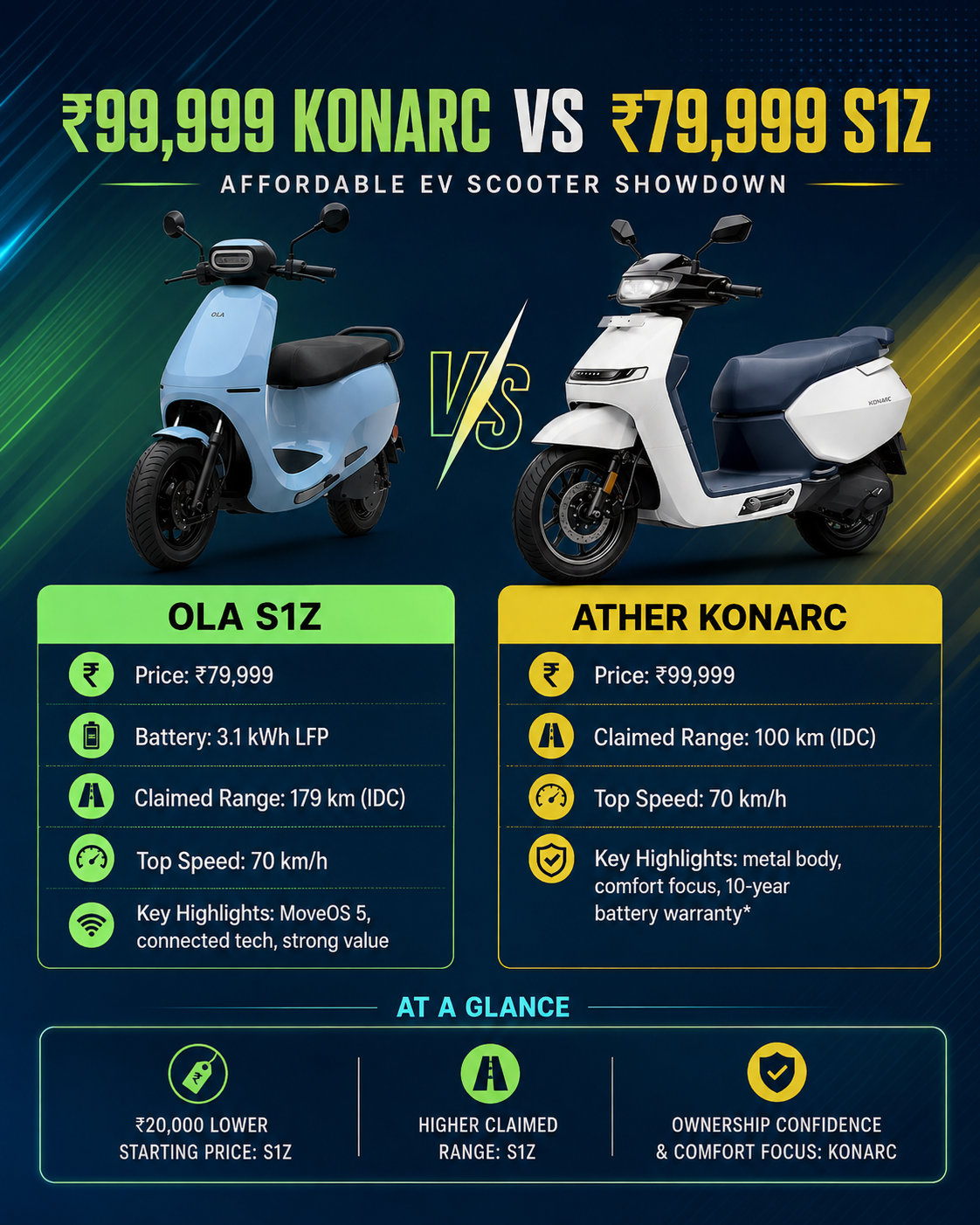
The Ola S1Z starts at ₹79,999, while the Ather Konarc S is priced from ₹99,999. On paper, Ola immediately appears to have the advantage, particularly when battery capacity and claimed range are considered.
The S1Z 3.1 kWh promises 179 km of IDC range, while the entry Konarc S is rated at 100 km. Ola also offers a 5.1 kWh version at ₹99,999 with a claimed 301 km IDC range.
But buying an electric scooter involves considerably more than comparing numbers on a specification sheet.
Ather is placing greater emphasis on chassis engineering, ride comfort, charging convenience, warranty coverage and ownership experience. Ola, meanwhile, is pursuing an aggressive value strategy built around battery capacity, range and connected technology.
So, which approach makes more sense?
Two EVs, Two Very Different Philosophies
The easiest way to understand this comparison is to look at what each company is prioritising.
Ola S1Z: More battery, more range and more technology for the money.
Ather Konarc: A more conventional family-scooter approach focused on comfort, durability and ownership convenience.
That difference becomes apparent across almost every major area of the two scooters.
1. Price-to-Range Ratio Strongly Favours Ola
If the first consideration is simply how far the scooter can travel on a charge, the S1Z has a significant advantage.
The entry-level S1Z 3.1 kWh costs ₹79,999 and has a claimed 179 km IDC range.
The Konarc S costs ₹99,999 and its entry configuration is rated at 100 km IDC range.
There is an even more striking comparison at the ₹1 lakh mark. Ola’s 5.1 kWh S1Z is priced at ₹99,999 and claims 301 km of IDC range.
That makes the battery proposition difficult for Ather to match.
Of course, IDC testing does not represent the distance every rider will achieve. Riding speed, traffic, temperature, load, road conditions and riding mode can all affect actual range.
Nevertheless, Ola has clearly pushed the limits of what buyers can expect in terms of battery capacity at this price point.
Our pick for range: Ola S1Z
2. Battery Approach Could Matter More Over Time
The two brands aren’t just competing on battery size; they are approaching battery technology differently.
Ola’s S1Z uses the company’s Bharat Cell LFP technology, incorporating 46-series lithium iron phosphate cells that Ola says are developed in-house and produced at its Gigafactory in India.
The focus here is on creating batteries with strong longevity and thermal characteristics while increasing local manufacturing and reducing dependence on externally sourced cells.
Ather’s proposition is less about showcasing cell technology and more about giving buyers confidence over the long term.
The Konarc is advertised with a 10-year battery warranty, subject to the applicable terms and conditions. For buyers concerned about potential battery replacement costs several years into ownership, that warranty can carry considerable weight.
So, the better choice depends on what matters more:
- Ola: Greater battery capacity and locally produced LFP technology
- Ather: Long-term battery warranty reassurance
Verdict: Too close to call
3. Don’t Expect a Major Performance Difference
Despite their different approaches, the entry-level scooters are surprisingly similar when it comes to outright performance.
The S1Z uses a 4 kW peak-output mid-drive IPM motor and has a claimed 70 km/h top speed.
The Konarc S also reaches a claimed 70 km/h.
Ather’s future Konarc Z is expected to increase the top speed to 80 km/h, but that is a different proposition from the entry S variant.
For city commuting, neither scooter is primarily designed as a high-performance machine. Their focus is everyday usability rather than outright acceleration or top speed.
Verdict: Draw
4. Ather Appears More Focused on Family-Scooter Comfort
Battery figures tell only part of the story.
Ather’s new EL platform has been developed with everyday Indian road conditions in mind. The Konarc gets a steel unibody chassis and metal body, along with long-travel suspension and a larger wheel setup.
Its 14-inch front wheel, approximately 100 mm of suspension travel and 1,352 mm wheelbase are intended to deliver greater stability and comfort.
That hardware could prove particularly useful for riders dealing with potholes, rough patches, speed breakers and frequent pillion use.
The S1Z takes a more cost-conscious approach, using 12-inch wheels while putting considerable emphasis on battery capacity and affordability.
A definitive winner will only emerge after both scooters are ridden back-to-back. However, based purely on their engineering priorities, the Konarc appears to have the stronger comfort-oriented setup.
Advantage: Ather Konarc
5. Charging Convenience Gives Ather Another Strong Argument
A massive battery isn’t necessarily useful if charging takes too long.
This is where Ather’s charging strategy becomes interesting.
The Konarc incorporates charging hardware into its architecture and supports home charging as well as access to Ather’s public fast-charging network. Ather highlights around two hours of super-fast home charging for compatible configurations.
The EL platform incorporates a 450W integrated onboard charger, while an optional portable charger can increase the combined charging output.
Ola’s larger battery packs take longer to charge. The 3.1 kWh S1Z requires a claimed 5 hours 42 minutes for a 0-80% charge, while the 5.1 kWh version takes approximately 6 hours 16 minutes.
There is an obvious trade-off: Ola stores substantially more energy, but Ather can make a quicker charging turnaround attractive for some users.
Advantage: Ather Konarc
6. Ola Packs an Impressive Amount of Software Into the S1Z
Affordable doesn’t necessarily mean basic when it comes to connected features.
Both S1Z variants operate with MoveOS 5, giving buyers access to a broad range of software functionality.
Depending on the feature set, this includes:
- OTA updates
- GPS tracking
- Live location
- Ride statistics
- Cruise control
- Regenerative braking
- Reverse/Easy Park
- Geo-fencing
- Time fencing
- Predictive maintenance
- Smartphone connectivity
The fact that Ola is offering this technology even on the entry-level S1Z strengthens its value proposition.
Ather has its own connected ecosystem, with features such as Google Maps integration, AtherStack, smartphone connectivity, theft and tow alerts and AutoHold.
The higher-spec Konarc Z is expected to add a TFT touchscreen, MagicKey and other additional features, while the Konarc S gets Ather’s DeepView display.
For buyers focused on the number of connected features available at the entry price, however, Ola has a strong argument.
Advantage: Ola S1Z
7. Long-Term Ownership Is Where Ather Fights Back
The initial purchase price isn’t necessarily the biggest expense over the entire life of an EV.
Battery durability, servicing, support and repair costs can become increasingly important as the scooter gets older.
Ola’s S1Z comes with a standard 3-year/40,000 km scooter warranty, with extended coverage options available from the manufacturer.
Ather counters with its advertised 10-year battery warranty, subject to the relevant conditions.
The Konarc is also being promoted with a one-year service interval, potentially reducing the frequency with which owners need to visit a service centre.
For someone intending to keep their scooter for many years, these ownership benefits could be more valuable than an exceptionally high IDC range figure.
Advantage: Ather Konarc
8. The Service Network Could Be the Real Decider
This is perhaps the most important factor that cannot be captured by a specification table.
As electric scooters become mainstream, customers are becoming more concerned about the practical ownership experience.
Questions such as these matter:
- How quickly can a scooter be repaired?
- How easily are replacement parts available?
- Is there a service centre close to home?
- What happens if the battery develops a problem?
- How dependable is after-sales support?
- What will the scooter be worth several years later?
Ola is expanding its physical retail strategy through dealer-operated stores, which could help increase its presence beyond major urban markets.
Ather, meanwhile, is positioning the Konarc around simpler servicing, longer service intervals and its existing charging and retail infrastructure.
Ultimately, this could be an area where the ownership experience matters more than the headline specifications.
Don’t Ignore the Delivery Timeline
There is another factor buyers need to consider: when each version will actually become available.
Ola plans to begin deliveries of the 3.1 kWh S1Z from December 2026, while the larger 5.1 kWh version is expected from March 2027.
Ather’s Konarc range will also arrive in stages. The 125 km and 161 km versions are expected earlier, while the ₹99,999 100 km entry version is scheduled for a later rollout. The longer-range variants will follow subsequently.
Therefore, the advertised price isn’t the only number buyers should look at.
The crucial question is:
Which variant can you actually get when you’re ready to buy?
The ₹99,999 Question
The biggest challenge for Ather is arguably the price overlap.
At ₹99,999, a customer can choose between the entry Konarc S and the larger 5.1 kWh S1Z.
The difference is substantial on paper:
| Ola S1Z 5.1 kWh | Ather Konarc S | |
|---|---|---|
| Price | ₹99,999 | ₹99,999 |
| Battery | 5.1 kWh | Entry configuration |
| Claimed IDC range | 301 km | 100 km |
| Top speed | 70 km/h | 70 km/h |
| Core proposition | Range & technology | Comfort & ownership |
Ather therefore cannot win this comparison by simply talking about range.
Its argument has to be based on how the scooter feels and performs over years of ownership.
That includes its chassis, ride comfort, charging system, warranty, service schedule and overall ecosystem.
Which Scooter Fits Which Buyer?
Ola S1Z 3.1 kWh: Best for Maximum Value
The entry S1Z makes the strongest case for buyers working with a tight budget.
At ₹79,999, the combination of a 3.1 kWh battery, 179 km claimed IDC range and MoveOS 5 gives it an impressive specification-to-price ratio.
If your priorities are low entry cost, generous claimed range and connected features, this is the more compelling option.
Ola S1Z 5.1 kWh: The Range Champion
If your budget extends to ₹99,999, the bigger S1Z becomes particularly difficult to overlook.
The 5.1 kWh battery and claimed 301 km IDC range are its biggest selling points.
For buyers who regularly travel longer distances or simply want to minimise charging frequency, the larger S1Z offers an unusually strong battery proposition for its price.
Ather Konarc: The More Ownership-Focused Choice
The Konarc makes more sense for buyers who aren’t prepared to judge an electric scooter purely by battery capacity.
Its metal body, steel unibody construction, 14-inch front wheel, comfort-oriented suspension, charging setup, long service interval and advertised 10-year battery warranty make it a potentially more appealing package for family users.
The trade-off is straightforward: you give up a substantial amount of claimed range in exchange for a product that puts greater emphasis on everyday usability and long-term ownership confidence.
Final Verdict
The Ola S1Z is the clear winner if specifications, battery capacity and price-to-range value are your primary criteria.
The ₹79,999 3.1 kWh version already offers a compelling package, while the ₹99,999 5.1 kWh model takes the value equation to another level with its claimed 301 km IDC range.
But that doesn’t automatically make the Konarc a poor choice.
Ather is playing a different game.
The Konarc is aimed at buyers who are willing to spend more for factors such as ride comfort, chassis engineering, charging convenience, battery warranty and potentially simpler long-term ownership.
So the decision ultimately comes down to priorities:
Want the maximum EV for your money? Pick the Ola S1Z.
Want a more ownership-focused family scooter and are willing to compromise on range? The Ather Konarc deserves serious consideration.
The real test will begin once both scooters are widely available and owners can judge their real-world range, ride quality, reliability, service experience and long-term running costs. That’s where the impressive numbers on paper will have to prove themselves on India’s roads.


