


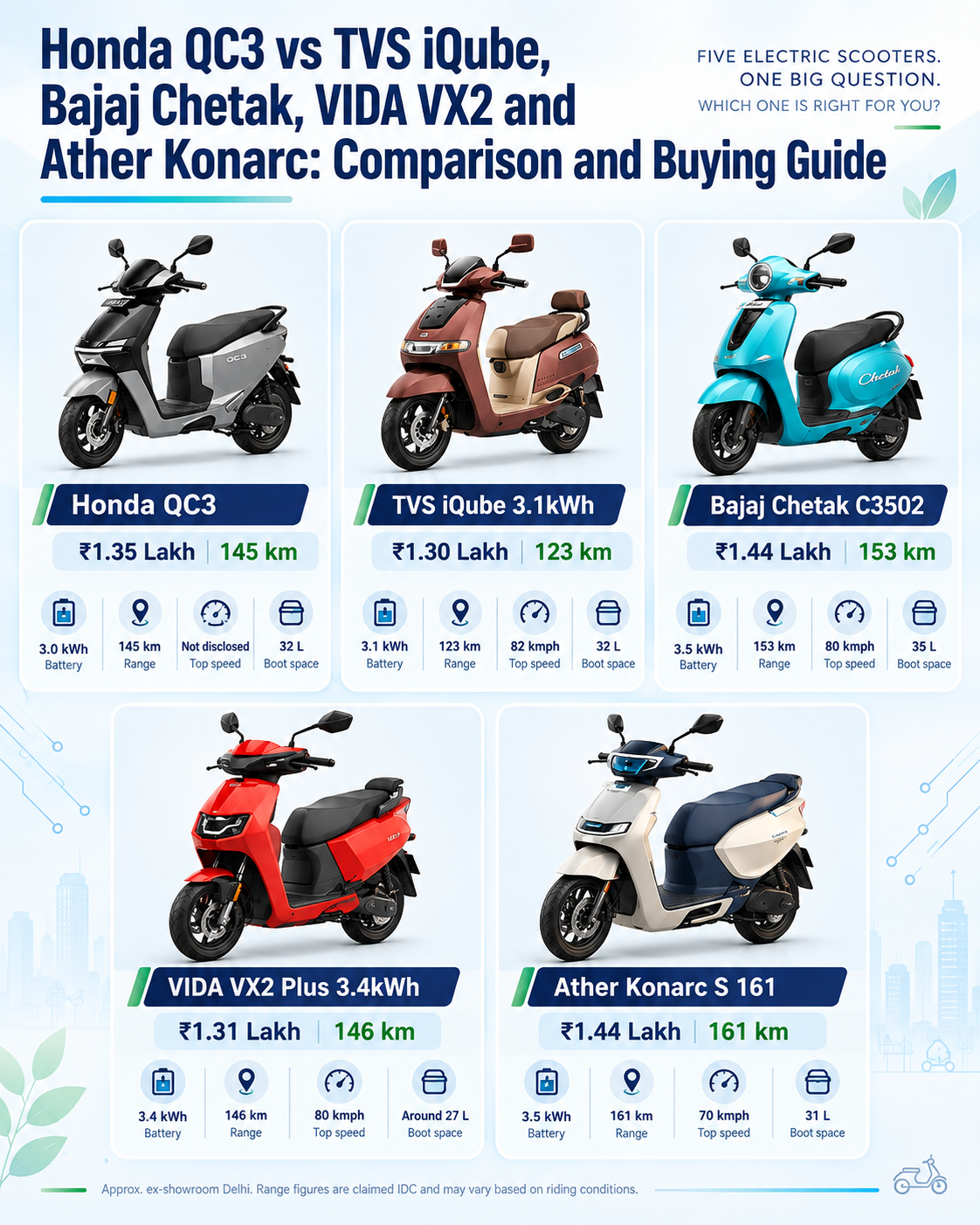
Honda has entered the mainstream electric scooter market with the QC3, priced at around ₹1.35 lakh (ex-showroom, Delhi). With a 3kWh battery, a claimed 145km IDC range, 32-litre storage and connected features, the QC3 enters a segment that already includes products such as the TVS iQube 3.1kWh, Bajaj Chetak C3502, VIDA VX2 and Ather Konarc S 161.
Each of these scooters takes a slightly different approach to everyday electric mobility. Honda focuses on a balanced family-oriented package, TVS combines practicality with established performance, Bajaj offers a metal-bodied scooter with additional storage, VIDA emphasises affordability and removable batteries, while Ather’s Konarc S 161 focuses heavily on claimed range and connected technology.
Electric Scooter Prices Compared
The approximate ex-showroom Delhi prices of the five models are:
| Model | Approx. Ex-Showroom Price |
|---|---|
| Honda QC3 | ₹1.35 lakh |
| TVS iQube 3.1kWh | ₹1.30 lakh |
| Bajaj Chetak C3502 | ₹1.44 lakh |
| VIDA VX2 Plus 3.4kWh | ₹1.31 lakh |
| Ather Konarc S 161 | ₹1.44 lakh |
Prices are approximate and can vary based on city-specific incentives, insurance, dealer charges, connected-service packages and promotional offers.
Range, Battery And Performance: At A Glance
| Model | Battery | Claimed IDC Range | Top Speed | 0–80% Charging | Storage |
|---|---|---|---|---|---|
| Honda QC3 | 3.0kWh | 145km | Not disclosed | 2 hr 40 min | 32 litres |
| TVS iQube 3.1kWh | 3.1kWh | 123km | 82kmph | 4 hr 03 min | 32 litres |
| Bajaj Chetak C3502 | 3.5kWh | 153km | 80kmph | 3 hr 25 min | 35 litres |
| VIDA VX2 Plus 3.4kWh | 3.4kWh | 146km | 80kmph | Check charger/plan | Around 27 litres |
| Ather Konarc S 161 | 3.5kWh | 161km | 70kmph | 5 hr 40 min with standard charger | 31 litres |
IDC figures are based on laboratory testing and should not be treated as real-world range. Actual range can change depending on speed, traffic, load, riding mode, tyre pressure and weather conditions.
Honda QC3: A Focus on Everyday Balance
The QC3’s appeal comes from the combination of range, storage and charging convenience.
Its claimed 145km IDC range puts it ahead of the iQube 3.1kWh and close to the VIDA VX2 Plus. The 32-litre under-seat storage also gives it enough room for everyday family use.
Honda has equipped the scooter with a Smart Key and 5-inch TFT display, with RoadSync connectivity and turn-by-turn navigation adding to its technology package.
Charging is another area where the QC3 has an advantage on paper. Honda claims an 80% charge in 2 hours 40 minutes and a full charge in roughly four hours. The 0–80% figure is quicker than the quoted charging times of the iQube, Chetak and Konarc S 161 when using the standard charger.
However, Honda has not disclosed all of the QC3’s performance specifications, including its top speed and motor output. Riders who regularly travel on faster roads or carry a passenger should therefore experience the scooter first-hand before making a decision.
TVS iQube 3.1kWh: Practicality With Familiar Ownership
The TVS iQube 3.1kWh takes a relatively straightforward approach to the family electric scooter segment.
Its claimed 82kmph top speed is the highest among the models listed here, while its 32-litre storage capacity matches the Honda QC3.
Another consideration is TVS’s established conventional dealership and service network, which can be relevant for buyers who prefer easier access to servicing and support.
The biggest compromise is its claimed range of 123km, which is lower than the figures quoted for all four alternatives in this comparison.
For a rider covering around 30–50km per day and charging at home, this may be adequate. Those with longer daily commutes may place greater importance on the additional range offered by the competing models.
Consider it if: you want a familiar family scooter, decent performance for city riding and access to an established service network.
Bajaj Chetak C3502: More Storage and a Metal Body
The Chetak C3502 sits towards the higher end of this group at approximately ₹1.44 lakh.
In return, it offers a 3.5kWh battery, 153km claimed IDC range and 80kmph top speed. Its 35-litre boot is also the largest among the five scooters compared here.
The steel body is another defining characteristic, giving the Chetak a different construction and feel compared with several rivals.
Its claimed 0–80% charging time of 3 hours 25 minutes is longer than Honda’s figure. Buyers should also check the exact equipment and connected features available with the optional TecPac.
Consider it if: build and metal-body construction, storage capacity and additional range are high on your list.
VIDA VX2: Affordable Entry With Battery Flexibility
The VIDA VX2 approaches electric scooter ownership differently by offering multiple battery configurations and ownership plans.
The VX2 Plus with a 3.4kWh battery has a claimed range of 146km and an 80kmph top speed, putting its headline specifications close to the Honda and Chetak.
One of its key advantages is the availability of removable batteries, which can make charging more convenient for people who live in apartments or locations without easy access to a parking-space charging point.
However, buyers need to examine the ownership structure carefully. Depending on the selected plan, the advertised entry price may not represent the entire cost of ownership because battery-related payments or usage-linked charges can apply.
Battery weight, charging convenience and the complete terms of the selected plan should also be checked before purchase.
Consider it if: keeping the initial cost lower or having removable batteries is important, provided the overall ownership cost fits your usage.
Ather Konarc S 161: Range Takes Priority
The Ather Konarc S 161 has one of the highest prices in this comparison at approximately ₹1.44 lakh, but it also posts the highest claimed range.
Its 3.5kWh battery is rated for 161km IDC, making it the range leader among these five scooters.
The trade-off comes in performance and charging. The S variant has a claimed 70kmph top speed, which is lower than the iQube, Chetak and VIDA VX2 Plus.
Storage remains practical at 31 litres, while Ather’s connected features and software ecosystem are another part of the package.
Using the standard 450W charger, Ather quotes around 5 hours 40 minutes for an 80% charge. The company’s combined-charging option can reduce charging time when compatible additional charging equipment is available.
Buyers should check exactly which charger and charging equipment are included with the quoted price.
Consider it if: maximum claimed range and connected technology matter more to you than top speed or standard charging time.
Which One Makes Sense for Different Buyers?
Honda QC3
The QC3 makes sense for buyers looking for a balanced family-oriented package, with useful storage, competitive claimed range and relatively quick charging. Its complete performance specifications are still important to verify.
TVS iQube 3.1kWh
The iQube suits buyers who prioritise an established product, higher claimed top speed and conventional service accessibility, particularly if their daily distance is relatively moderate.
Bajaj Chetak C3502
The C3502 is worth considering for buyers who want metal construction, generous storage, an 80kmph top speed and a 153km claimed range, and are comfortable paying more.
VIDA VX2
The VX2 is aimed at buyers who place greater importance on upfront affordability and removable-battery convenience. The full cost of the selected ownership plan should be compared over several years.
Ather Konarc S 161
The Konarc S 161 is targeted at riders who want the highest claimed range in this group along with Ather’s software and connected ecosystem, while accepting its lower top speed and longer standard charging time.
Final Takeaway
The five scooters are not identical alternatives despite occupying a similar price bracket. Their strengths are spread across different areas: Honda focuses on balance, TVS on familiar practicality, Bajaj on construction and storage, VIDA on ownership flexibility, and Ather on claimed range and software.
For buyers, the most useful comparison therefore goes beyond the ex-showroom price. Daily running distance, charging access, storage requirements, battery ownership terms, service availability and preferred riding conditions should all be considered before choosing an electric scooter.


