


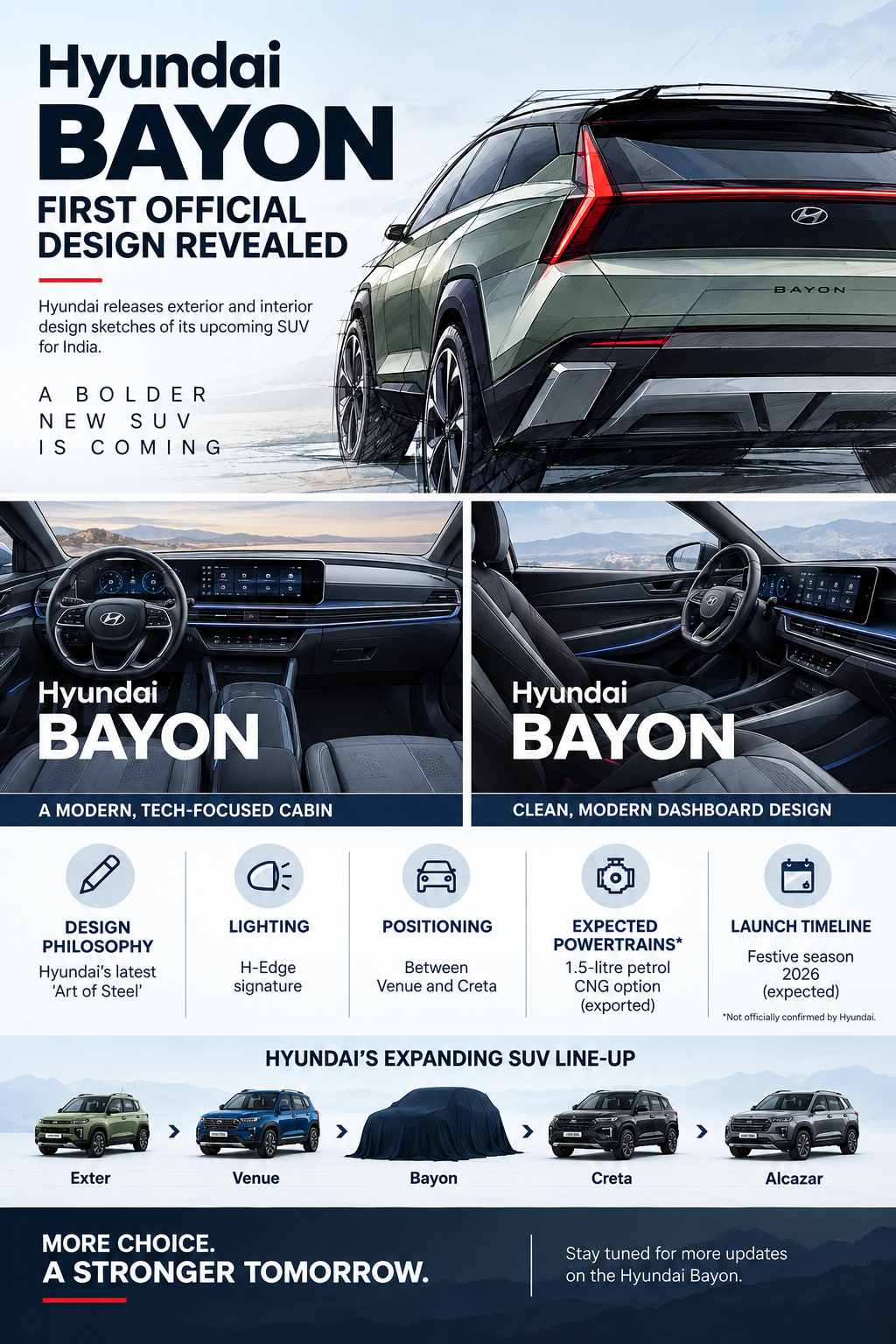
Hyundai Motor India has offered the first official glimpse of the upcoming Hyundai Bayon, releasing design sketches that reveal the SUV’s exterior and interior styling ahead of its India launch.
The design preview follows Hyundai’s confirmation of the Bayon nameplate for the Indian market. The upcoming SUV is expected to strengthen Hyundai’s SUV range by filling the space between the Venue and Creta.
Until now, most sightings of the India-spec Bayon have involved camouflaged test vehicles. The latest official sketches provide a much clearer indication of what the production SUV is expected to look like and highlight Hyundai’s evolving design language.
Hyundai Bayon Exterior Design: What the Sketches Reveal
For the India market, the Bayon will follow Hyundai’s latest “Art of Steel” design philosophy. The styling combines sharp character lines and pronounced body contours with a more upright SUV profile.
The front section gets Hyundai’s new H-Edge lighting signature, along with a broad front fascia and a sculpted bonnet. The pronounced wheel arches and strong surfacing give the SUV a more substantial appearance.
From the side, the design sketch shows a prominent shoulder line, muscular-looking fenders and relatively large alloy wheels. The rear follows the same angular design theme, featuring a wide tailgate and distinctive lighting elements.
These design cues indicate that the India-spec Bayon could have a more traditional SUV appearance, rather than closely mirroring the crossover-oriented styling of the Bayon currently sold in international markets.
Hyundai Bayon Interior Design Preview
Alongside the exterior, Hyundai has also released an initial sketch of the Bayon’s interior.
The cabin appears to feature a wide, horizontal dashboard layout with a prominent digital interface. Hyundai has focused on creating a modern and technology-oriented environment while keeping the overall dashboard design relatively uncluttered.
There are also noticeable similarities between the Bayon’s dashboard concept and the interior design seen on the recently revealed new-generation i20.
Hyundai has yet to confirm the production-specification details, including the exact display sizes, infotainment system and other cabin features. These details are expected to be announced closer to the SUV’s launch.
Where Will the Bayon Fit in Hyundai’s SUV Line-up?
The Bayon is expected to occupy the space between Hyundai’s Venue and Creta.
If Hyundai follows this positioning, its SUV portfolio could be structured as:
Exter → Venue → Bayon → Creta → Alcazar
The new SUV could therefore appeal to buyers seeking something larger and more substantial than a sub-four-metre SUV, while offering an alternative to moving directly into the Creta segment.
This positioning would also allow Hyundai to cover another price and size bracket as demand for SUVs continues to grow in India.
Hyundai Bayon Engine Options: What We Know So Far
Hyundai has not yet released the official powertrain details for the India-spec Bayon.
According to current reports, the SUV could be offered with a 1.5-litre petrol engine, while a CNG version is also reportedly under consideration.
Details regarding power output, transmission options and the final engine line-up have not been confirmed by Hyundai.
The international Bayon uses a different range of powertrains, so the India-specification model should not be directly compared with its overseas counterpart until Hyundai reveals the official technical details.
India Launch Could Take Place During the 2026 Festive Season
The Hyundai Bayon is expected to launch in India during the 2026 festive season, with reports currently suggesting an October or Diwali-period introduction.
Hyundai is yet to announce the exact launch date, pricing, variants and complete equipment list.
With the nameplate now officially confirmed and the first design sketches out, the Bayon’s India introduction is moving closer, with more details likely to emerge as the launch approaches.
Hyundai Bayon’s Role in the Indian Market
The upcoming Bayon is expected to give Hyundai an additional option in an increasingly crowded SUV market.
The Venue currently serves Hyundai in the sub-four-metre SUV space, while the Creta caters to the midsize SUV segment. The Bayon could bridge the gap between these two products, giving buyers another option in terms of size, positioning and features.
Importantly, the Bayon does not appear to be replacing an existing Hyundai SUV. Instead, it is expected to expand the company’s portfolio with a new model positioned between the Venue and Creta.
Its success will ultimately depend on pricing, features, powertrain choices and how Hyundai positions the SUV against its rivals once the complete India-specification details are revealed.


