


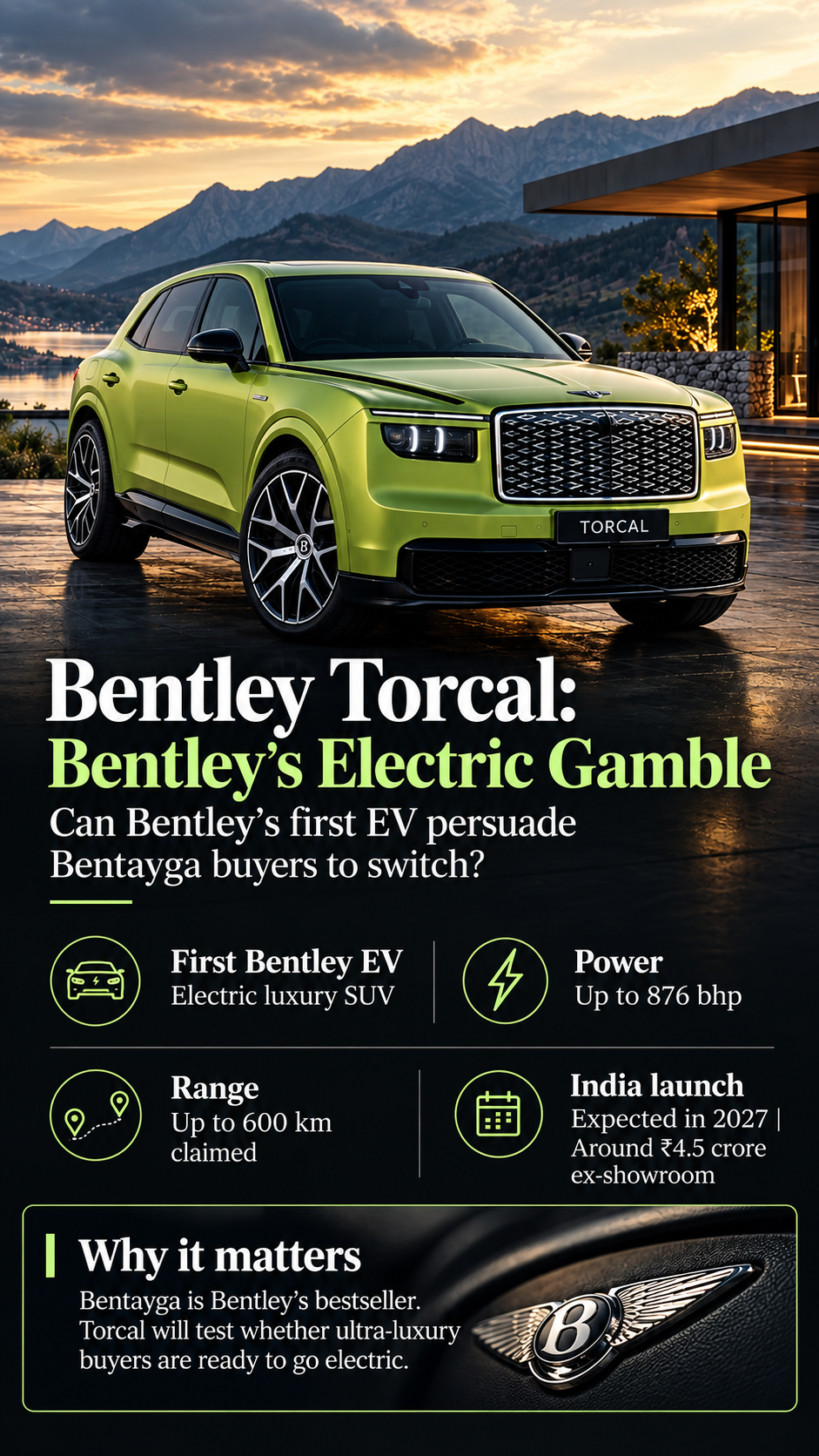
Bentley is preparing to enter the electric vehicle space with an SUV, and its choice reflects the growing importance of the body style to the luxury carmaker. The Bentayga has established itself as Bentley’s best-selling model, making an SUV a natural starting point for the brand’s move towards fully electric vehicles.
The upcoming Bentley Torcal will become the company’s first fully electric production model. In India, the luxury electric SUV is expected to arrive in the second half of 2027, with an estimated ex-showroom price of around ₹4.5 crore.
More than just another electric luxury SUV, the Torcal represents a significant shift for Bentley as it looks to combine its traditional focus on luxury and performance with an all-electric powertrain.
Why Bentley Chose an SUV for Its First EV
Bentley had several options for introducing its first electric model, including electrifying the Continental GT or Flying Spur. Instead, the company has chosen to build its EV strategy around an SUV.
There is a clear business reason behind the decision. The Bentayga remains Bentley’s highest-volume model globally, accounting for around 44% of the company’s global sales in 2023.
The success of the Bentayga has given Bentley considerable experience in the luxury SUV segment. The Torcal allows the company to take that familiarity into the electric vehicle market while introducing an entirely new model line.
However, the Torcal isn’t simply an electric replacement for the Bentayga. It is slightly smaller and has been developed from the ground up around an electric powertrain. Bentley sees the model as an important foundation for its upcoming generation of EVs.
Bentley Torcal: Performance and Battery Details
Underneath its luxury-focused exterior, the Torcal uses an 800V electrical system paired with a 113kWh usable battery.
The key specifications currently associated with the SUV include:
- Power: Up to 888 PS
- Torque: 1,350 Nm
- Powertrain: Dual electric motors
- 0-100 km/h: 2.9 seconds in the top-spec version
- Range: Approximately 600 km WLTP
- DC charging: Up to 400kW
- 10-80% charging: Around 16 minutes
The electric SUV is based on the Volkswagen Group’s Premium Platform Electric (PPE) architecture, placing it within the same broader technical family as the electric Porsche Cayenne.
Bentley has also equipped the Torcal with features including active suspension, rear-wheel steering and multiple cameras, radar and driver-assistance systems.
Can an EV Deliver the Traditional Bentley Experience?
Straight-line performance is unlikely to be the biggest hurdle for Bentley.
With as much as 888 PS and 1,350 Nm, the Torcal has more than enough power to deliver the kind of acceleration expected from an ultra-luxury performance SUV. The more important question is whether Bentley can reproduce the character and sense of occasion associated with its traditionally powered cars.
Electric powertrains already offer several qualities that fit naturally into the luxury segment. Instant torque, smooth acceleration and low operating noise can all contribute to a refined driving experience.
However, the transition also means giving up one of the elements historically associated with Bentley ownership: its powerful internal-combustion engines.
The Torcal will therefore need to create a different interpretation of the Bentley experience rather than simply trying to replicate it without an engine.
What Could the Bentley Torcal Cost in India?
The expected ₹4.5 crore ex-showroom price would put the Torcal firmly into India’s ultra-luxury EV space.
Its pricing could become an important consideration when compared with Bentley’s combustion-powered models. The Torcal may not benefit from the same customs-duty treatment that certain UK-built combustion vehicles could receive under the India-UK trade framework, potentially pushing up its effective price in the country.
At this level, however, buyers are unlikely to evaluate the SUV primarily on conventional EV considerations such as fuel savings.
The Torcal’s appeal will instead centre around exclusivity, technology, performance and its status as Bentley’s first production EV.
India’s Charging Network Could Pose a Challenge
The Torcal’s hardware is designed for extremely fast charging. Its 400kW maximum DC charging capability and claimed 10-80% charging time of approximately 16 minutes are among its headline technical features.
However, making full use of those numbers in India could prove difficult because public charging infrastructure currently has limited availability of chargers operating at such high power levels. This infrastructure challenge has also been highlighted in early coverage of the vehicle.
For Bentley customers, the impact could be less significant than it would be for mainstream EV buyers.
Owners of vehicles in this segment are more likely to have access to private parking, home charging or premium destination charging facilities. With a claimed WLTP range of around 600 km, the Torcal should also be capable of covering most regular journeys without frequent reliance on public fast chargers.
Bentley’s EV Roadmap Has Become More Flexible
The Torcal arrives at a time when Bentley itself has adjusted its approach to electrification.
The company had previously targeted an all-electric lineup by 2030, but that strategy was later revised as demand for high-end electric vehicles developed more gradually than anticipated.
Bentley is now pursuing a broader transition involving both plug-in hybrid and fully electric models, rather than moving immediately away from combustion engines.
That makes the Torcal more significant than simply being Bentley’s first EV. It will provide the company with an indication of how its existing luxury-car customers respond to a fully electric Bentley.
For now, the Torcal represents Bentley’s first major step into the electric era — combining ultra-luxury, supercar-like performance and long-range EV technology in an SUV format that has already proven successful for the brand.


